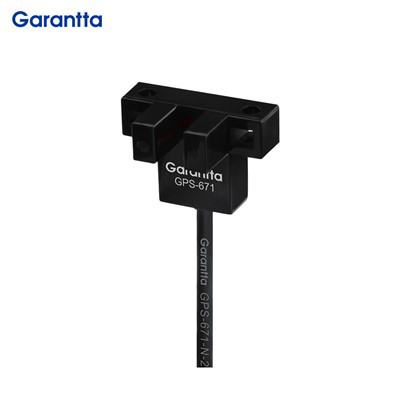
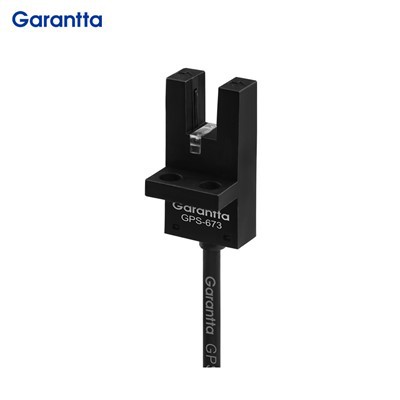
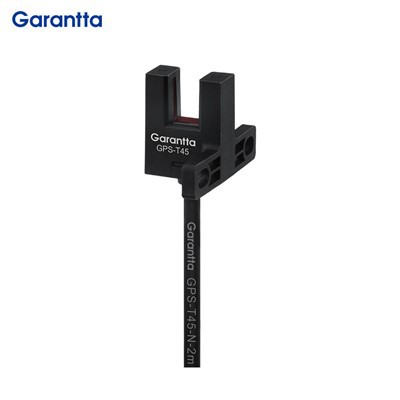
Garantta Slot Photoelectric Sensor (GPS‑65 Series: GPS‑L65, GPS‑R65, GPS‑T65, GPS‑Y65, GPS‑F65) is a miniature U‑slot (fork‑type) through‑beam photoelectric sensor designed for confined‑space industrial automation Garantta . Integrating infrared emitter and receiver inside one compact U‑shaped housing, this micro photoelectric sensor comes with factory‑calibrated optical axis, eliminating tedious manual alignment during field installation. When opaque targets pass across the slot gap and block the infrared light beam, the sensor outputs reliable switching signals for object presence checking, high‑speed counting, rotary origin detection, stroke limit and homing trigger. Different from standard‑size photoelectric sensors, Garantta micro slot photoelectric sensor features ultra‑small footprint, shock‑resistant resin housing and built‑in amplifier, which makes it ideal for compact equipment such as 3C assembly machines, small packaging devices and laboratory test jigs Garantta
Features
1. The GPS-65 series is a U-shaped Micro Photoelectric Sensor with a built-in amplifier
2. Comes with 3 protection circuits as standard
Power reverse connection protection circuit
Output reverse connection protection circuit
Output short-circuit protection circuit
Through the above-mentioned standard circuit configuration, the risk of sensor failure caused by incorrect wiring is greatly reduced.
3. Large and clear multi-angle action indicator light, which can be confirmed not only from above, but also from the side
4. The resin structure is resistant to vibration and impact
Use resin to cover stress-concentrated locations such as cables and internal circuit joints. This structure can effectively reduce the risk of failure caused by vibration and impact.
Functions
1. Detect the starting point of the rolling object; the starting point can be detected through the slit on the rotating object
2. Verify the position of the template; when the baffle is detected, the template stops running
3. Detect the starting point and over-limit movement without a movement diagram; use the stop on the base to detect the starting point and over-limit movement

Hot Tags: micro photoelectric sensor, China micro photoelectric sensor manufacturers, suppliers, factory, t slot photo interrupter, T Slot Sensor Kits, U-type photoelectric sensor, Slot Type Photomicrosensors, Slotted Optical Sensor, groove photoelectric sensors