

Welcome all friends to be our Photoelectric Sensor Agent. More details, please feel free to contact us (info@garantta.com)
As one of the professional Photoelectric Sensor manufacturers and suppliers in Shenzhen, China, we can also provide you with other sensor products(safety light curtain, proximity sensors, laser sensors, fiber optic sensors, color mark sensors, ultrasonic sensor, etc.) Welcome to wholesale the best sensor products at a competitive price from our factory.
-
![Photoelectric Reflective Sensor]() Photoelectric Reflective Sensor1. The square design typically provides a larger heat dissipation area, which is beneficial for long-term stable operation. . 2.The top potentiometer for sensitivity adjustment and standard mountingread more
Photoelectric Reflective Sensor1. The square design typically provides a larger heat dissipation area, which is beneficial for long-term stable operation. . 2.The top potentiometer for sensitivity adjustment and standard mountingread more -
![Photoelectric Slot Sensor]() Photoelectric Slot Sensor1. A compact, integrated through-beam structure that precisely integrates the infrared transmitter and receiver on both sides of a tiny U-shaped slot, forming a built-in fixed optical axis. . 2.read more
Photoelectric Slot Sensor1. A compact, integrated through-beam structure that precisely integrates the infrared transmitter and receiver on both sides of a tiny U-shaped slot, forming a built-in fixed optical axis. . 2.read more -
![M18 Optical Sensor]() M18 Optical Sensor1. The M18 standard thread (18mm diameter) allows for direct installation in standard threaded holes or nuts, saving space. . 2. Compared to metal housing models, the plastic housing makes itread more
M18 Optical Sensor1. The M18 standard thread (18mm diameter) allows for direct installation in standard threaded holes or nuts, saving space. . 2. Compared to metal housing models, the plastic housing makes itread more -
![BGS Photoelectric Sensor]() BGS Photoelectric Sensor1. Completely solves the false triggering problem caused by background interference in traditional photoelectric sensors. . 2. As long as an object is within the set distance, it can be reliablyread more
BGS Photoelectric Sensor1. Completely solves the false triggering problem caused by background interference in traditional photoelectric sensors. . 2. As long as an object is within the set distance, it can be reliablyread more -
![Diffuse Reflective Photoelectric Sensor]() Diffuse Reflective Photoelectric Sensor1. The transmitter and receiver are integrated into the same square housing, allowing operation with only one-sided installation. . 2. Utilizing photoelectric principles, it operates by detecting theread more
Diffuse Reflective Photoelectric Sensor1. The transmitter and receiver are integrated into the same square housing, allowing operation with only one-sided installation. . 2. Utilizing photoelectric principles, it operates by detecting theread more -
![Transparent Object Photoelectric Sensor]() Transparent Object Photoelectric SensorGarantta GPS‑B61 Transparent Object Photoelectric Sensor reliably detects transparent PET bottles, glass bottles and thin plastic films. Built‑in proprietary algorithm suppresses ambient lightread more
Transparent Object Photoelectric SensorGarantta GPS‑B61 Transparent Object Photoelectric Sensor reliably detects transparent PET bottles, glass bottles and thin plastic films. Built‑in proprietary algorithm suppresses ambient lightread more


008613530821762
info@garantta.com
008613530821762

Square Photoelectric Sensor
- Various detection methods, including diffuse reflection, through-beam, mirror reflection, background suppression, and transparent bottle retro-reflection
- Built-in amplifier, resistant to light interference
- Easy to operate, good performance
Cylindrical m18 photoelectric sensor
- Different detection methods, including diffuse reflection, through-beam, retro-reflective, and background suppression
- Easy installation, highly user-friendly
- High-strength ABS shell material, compact and sturdy
- Strong resistance to external light disturbance and electromagnetic interference
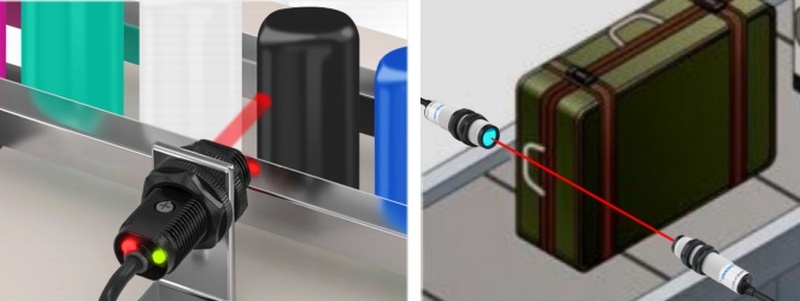

Slot Photoelectric Sensor
- High cost performance, multiple models available, GPS-67 series, GPS-25 series, GPS-45 series, GPS-65 series
- Small and light, suitable for tightly install
- Equipped with 2 independent outputs
- Equipped with an output reverse connection protection function
Ultra-thin Photoelectric Sensor
- Ultra-thin, small size, flexible installation
- Narrow light type, the beam spread is about 1/2 ofthe standard type
- Not affected by the background
- Equipped with an anti-frequency light circuit

01-Fast response speed
Optoelectronic sensors are based on the principle of photoelectric conversion and have a very fast response speed. They can achieve high-frequency detection and are suitable for application scenarios that require fast response
02-High resolution
Through precise optical design, photoelectric sensors can achieve high-resolution detection, capable of detecting small objects or fine positional differences
03-Long detection distance:
Our Garantta throgh-beam photoelectric sensors can achieve a longer detection distance(max sensing distance= 40m), which is an advantage that other types of sensors cannot match in certain applications
04-Strong anti-interference ability
Some special photoelectric sensors, such as our Garantta background suppression photo electric sensors which have strong anti-interference ability and can effectively avoid the influence of background factors on detection
Basic installation precautions
1. Avoid strong light sources: Avoid aligning the sensor's optical axis directly with strong light sources such as sunlight and incandescent bulbs. If it cannot be avoided, a light shielding plate or a long light-shielding tube can be installed around the sensor.
2. The impact of chemicals: The lens of the infrared photoelectric sensor can be wiped with lens paper, and chemicals such as diluent solvents are prohibited to avoid permanent damage to the plastic mirror.
3. The influence of environmental factors: Avoid using photoelectric switch sensors in places with high levels of dust, corrosive gases, water, oil, and chemicals that may directly splash. At the same time, it should be avoided to install in places where the environmental temperature changes beyond the product's specified range or where there is significant vibration or impact without taking shock absorption measures.
4. Specific installation requirements for sensor types: Diffuse reflective photo sensors should be installed within the distance of detecting object movement to avoid working in critical states. The reflective plate photoelectric sensor should ensure that the reflective plate is aligned and installed parallel to the detection area. When multiple sensors are installed simultaneously and nearby, attention should be paid to the installation method of the sensors to prevent mutual interference between them.
5. Consideration of installation location: Ensure that the installation location of the sensor can cover the area to be detected and avoid blind spots. Meanwhile, considering that the light beam of the sensor may become larger due to the divergence of light, attention should be paid to the minimum distance between sensors during installation to prevent mutual interference.
Application of photoelectric sensors
Optical sensors are one of the most produced and widely used sensors at present. They are widely used in various fields such as military, aerospace, communications, smart home, smart transportation, security, LED lighting, toys, detection, and industrial automation control.


why choose Garantta Photoelectric Sensor
One-stop Solution
Main products included safety light curtains, measuring light curtains, photoelectric sensors, proximity sensors, color mark sensors, fiber optic sensor,s etc.
Welcome Global Agent
Our factory is in Dongguang City, and our sales office is in Shenzhen City, welcome to visit us at any time
Experienced Engineers
50+ skilled workers; 7+ experienced engineers; 5+ professional international sales
Quality & Technical Support
3 years quality warranty and all-life technical support, there is no worried on after-sales service
First, click on our website www.garantta.com, find the Photoelectric Sensor model you want, contact the sales on our website, and discuss the order details in detail.
1. What is the nature of the object being detected: solid, liquid, granular, metal, etc.?
2. What is the distance between the sensor and the object?
3. What is the shape of the object being detected?
Our address
Room 1007-1008, 10th Floor, Building 7, Hengda Fashion Valley, Dalang Street, Longhua New District, Shenzhen
Phone Number
+86 13530821762
info@garantta.com
ga00004@garantta.com

FAQ
Q: Precautions for using the photoelectric switch sensor
A: Places where through-beam photoelectric sensors should be avoided
1. Places with a lot of dust;
2. Places with a lot of corrosive gases;
3. Places where water, oil, and chemicals may splash directly;
4. Places where there is direct strong light such as outdoor or sunlight without shading measures.
Places where the ambient temperature changes beyond the specified range of the product; places with large vibration and impact, but no shockproof measures are taken. Precautions for the use of photoelectric sensor switch
1. Avoid strong light sources photoelectric switch sensors can generally work stably when the ambient illumination is high. However, avoid facing the sensor's optical axis directly to strong light sources such as sunlight and incandescent lamps. When the angle between the optical axis of the sensor (receiver) and the strong light source cannot be changed, a shading plate or a shading tube can be installed around the sensor.
2. Prevent mutual interference Photoelectric beam sensors usually have the function of automatically preventing mutual interference, so there is no need to worry about mutual interference. However, when several groups of through-beam infrared photoelectric sensors are installed in parallel and close to each other, adjacent groups and mutual interference should be prevented. The most effective way to prevent this interference is to cross-set the projector and the receiver and to open the group distance when there are more than 2 groups. Of course, using models with different frequencies is also a good way.
3. Mirror angle effect When the object to be measured is shiny or encounters a smooth metal surface, the reflectivity is generally very high, which has a mirror-like effect. At this time, the projector and the detected object should be installed at an angle of 10 to 20 degrees so that its optical axis is not perpendicular to the object to be detected, thereby preventing false operation.
4. Eliminate the influence of background objects When using a reflective diffusion projector and receiver, sometimes the photo reflective sensor may not be able to detect stably because the detected object is close to the background object, or the proximity photo sensor or the background is a smooth object with high reflectivity. Therefore, you can use a distance-limited projector and receiver instead, or use methods such as moving away from the background, removing the background object, painting the background object matte black, or trying to make the background object rough and dark to eliminate it.
Q: Where are photo reflective sensors used?
A: Checking objects on a production line or conveyor: Photoelectric sensors can detect the size of items to find any errors, or simply find their absence, as well as pick up problems such as misaligned caps on bottles. They are widely used in the food and pharmaceutical industries and packaging plants.
Q: What are the advantages of photo sensors?
A: It has a longer life, a long sensing range, and is very reliable. Its response time is very fast, and it costs less.
Q: How do photo electric sensors detect the presence of objects?
A: Photoelectric sensors mainly consist of a transmitter that emits light and a receiver that receives light. When the emitted light is interrupted or reflected by the sensing object, it changes the amount of light reaching the receiver. The receiver detects this change and converts it into an electrical output.
Q: How are photoswitch sensors used?
A: Photoelectric sensors emit a beam of light (visible or infrared) from their light-emitting element. Reflective photoelectric sensors are used to detect beams reflected from a target. Through-beam sensors are used to measure the change in the amount of light caused by the target crossing the optical axis.
Q: What are the two basic components of a photoelectric sensor?
A: Basically, a photo-electric sensor has two main components. They are the transmitter (light source) and the receiver (sensor).
Q: What are the three basic parts of a optical sensor?
A: A optical sensor consists of a light source, a light receiver, a main circuit and an output circuit, and each part has the following functions. The photodiode and phototransistor of the light receiver receive the light emitted from the light source and convert it into an electrical signal.
Q: How to test a reflective photoelectric sensor?
A: The easiest way to determine how a photoelectric tube works is to connect a multimeter in resistance measurement mode to the two leads and see how the resistance changes when you cover the sensor with your hand, turn off the light, etc. Because the resistance changes a lot, an automatic range meter works well here.
Q: What are the reasons for the unstable output signal of the photoelectric sensor?
A: The following situations may cause the output signal of the photo electric sensor to be unstable when detecting objects:
①Abnormal power supply;
②Detection frequency is too fast;
③Size problem of the object to be measured;
④The object to be measured is not within the stable detection area of the sensor;
⑤Electrical interference.
Countermeasures:
①Supply a stable voltage to the sensor, and the supplied current must be greater than the current consumption of the sensor.
②The speed at which the object to be measured passes must be slower than the response speed of the sensor;
③The size of the object to be measured must be larger than the standard detection object or the minimum detection object;
④The object to be measured must be detected within the stable detection range of the sensor;
⑤Corresponding protective measures can be taken, such as: making a shielding cover around the probe, grounding the high-power equipment, etc.
As one of the leading photoelectric sensor manufacturers and suppliers in China, we warmly welcome you to buy discount photoelectric sensor for sale here from our factory. All our products are with high quality and competitive price.
photooelectric sensor for curvilinear object detection, photooelectric sensor for machined object detection, photooelectric sensor for uncut object detection