

On precision automated production lines, many inspection stations are space-constrained, making it difficult to embed traditional laser displacement sensors; contact probes are also prone to scratching workpieces and wear drift. Garantta's LDS-DE series miniature laser displacement sensors, with their compact design and triangulation solution, have been implemented on multiple production lines. Below are three real-world application cases showcasing the performance of this Garantta laser displacement sensor in actual field measurements.
Case 1 | Online Detection of Warpage and Gap in 3C Plastic Housings. A 3C component manufacturer in South China encountered a problem at its ultra-thin plastic housing assembly station: the reserved installation space at the station was extremely small, manual sampling was inefficient, ordinary laser displacement sensors were too large to install, and reflective plastic surfaces easily caused data jumps, leading to frequent missed detections of warpage and assembly gaps.
Solution: The equipment integrator selected Garantta's LDS-DE miniature laser displacement sensors, embedding them into the narrow space on the side of the tooling, deploying them at multiple points, simultaneously collecting height data, and calculating the flatness of the housing and the gaps in the snap-fit assembly in real time. The LDS-DE laser spot is fine and features a built-in surface reflection compensation algorithm, providing stable micron-level measurement results for both matte and glossy plastics. High-speed sampling, combined with dual outputs of digital and analog signals, allows direct data connection to a PLC. Any deviation from tolerance triggers an alarm and automatic rejection.
Implementation Results: Enables full inspection instead of sampling, significantly reducing defective output. No modifications to existing equipment racks are required, resulting in a short upgrade cycle. Customer feedback indicates that this miniature laser displacement sensor has demonstrated controllable zero-point drift and simple debugging in continuous operation in dusty workshop environments, reducing reliance on imported laser displacement sensors.
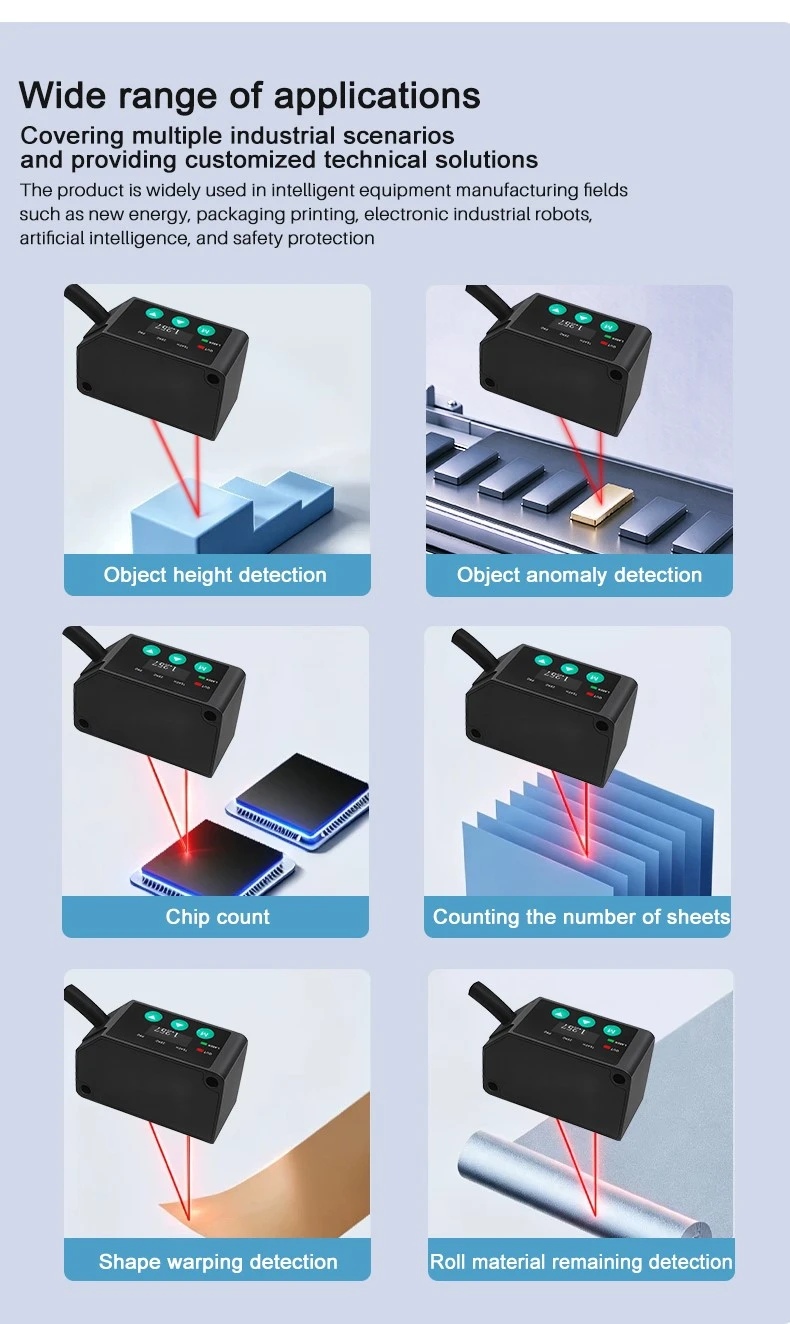
Case Study 2 | Lithium-ion Battery Cell Pressing Height and Step Difference Monitoring: In new energy lithium-ion battery PACK lines, the height and tab step difference after cell pressing directly affect subsequent packaging safety. Existing contact probes frequently experience impacts and wear under high-speed transport conditions, requiring frequent shutdowns for calibration; while conventional laser sensors cannot fit in the compact space near the pressing head.
Solution: A Granta LDS-DE series laser displacement sensor is used on-site, fixed within the limited space on the side of the pressing module. It continuously monitors the height of the cell top surface and the tab step difference in a non-contact manner, uploading the measurement curve to the MES in real time for quality traceability data. Even with an insulating coating on the cell surface, LDS-DE can still reliably identify it, unaffected by slight coating color differences.
Implementation Results: Eliminates easily worn contact probes, reducing downtime for maintenance; measurements remain stable even after production line speed increases, helping customers intercept dimensional defects in cell pressing at the upstream stage, improving batch consistency of batteries. It is a reliable solution for online lithium battery inspection in confined spaces.
Case Study 3 | Online Thickness Monitoring of Rubber Film Extrusion: A sealing material manufacturer's extrusion production line continuously produces ultra-thin rubber films, requiring full-process monitoring of thickness uniformity. The film is soft, and contact rollers easily leave indentations; the installation space on both sides of the extruder frame is narrow, leaving very limited installation margin for sensors.
Solution: Garantta LDS-DE miniature laser displacement sensors are arranged in pairs for vertical distance measurement, calculating film thickness in real time. The miniature body is smoothly embedded in the narrow area behind the extrusion die, capturing data fluctuations caused by film vibration at high speed. Software sets upper and lower thickness limits; when the thickness is too thin or too thick, it automatically sends speed adjustment signals to the extruder, forming a closed-loop control.
Implementation Results: The entire process is non-contact, preventing damage to the soft rubber substrate; thickness fluctuations are controlled in real time, reducing scrap rates; compared to imported miniature laser displacement sensors of the same type, procurement and after-sales costs are more favorable.
Garantta sensors can provide sample testing, on-site condition assessment, and matching debugging guidance. If your production line is facing the challenge of high-precision measurement in confined spaces and you are looking for a stable domestic miniature laser displacement sensor, please visit the Garantta website https://www.garantta.com, download the LDS-DE series datasheet, and contact us for a customized online detection solution.