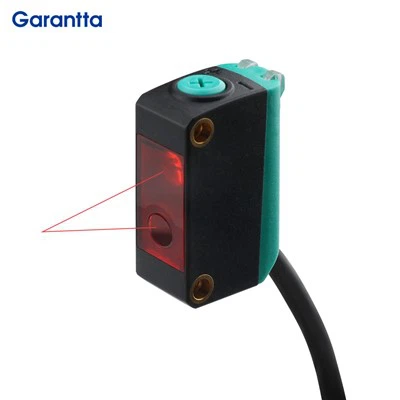
The Garantta GCS101 is a digital Optical Color Sensor that combines high precision, high speed, and a compact design. It excels at accurately identifying colors and mark positions on high-speed production lines or in complex environments, and is widely used in packaging, printing, and other industries.
The Garantta GCS111 is a "speed expert" focused on stability and cost-effectiveness, while the Garantta GCS101 is a "color expert" that further emphasizes precision and intelligence. If your production line speed is extremely high, you primarily detect black and white or high-contrast marks, and you want to control costs, the Garantta GCS111 might be more suitable. However, if you need to handle more complex colors, finer color differences, and want to reduce debugging efforts, the intelligent Garantta GCS101 would be a better choice.
| Quantity | Unit price (GCS101-N/GCS101-P) |
| 1-50pcs | 60usd/pcs |
| 50-100pcs | 58usd/pcs |
| ≥100pcs | 56usd/pcs |
Features of Optical Color Sensor
I. Intelligent Light Source and Detection Modes
Light Source: RGB three-color composite LED, wide detection range.
Automatic Light Selection: In color mark mode, automatically selects the optimal single-color LED to improve contrast and stability.
Dual Modes:
Color Mark Mode: Single color, 45μs ultra-high speed, used for positioning.
Color Mode: RGB three-color, analyzes reflectance ratio, used for color identification.
II. User-Friendly Settings
Operating Interface: 4-digit LED digital display, real-time information visible, beginner-friendly navigation.
Teaching Function: Supports multiple setting methods such as 2-point/fully automatic/1-point.
III. Robust Design
Dimensions: Small and compact, easy to install.
Protection: IP67 rating, resistant to harsh environments.
Applications of Optical Color Sensor
Thanks to its precise, fast, and stable characteristics, the GCS101 is widely used in the following fields:
1. Packaging Industry: Used in packaging machines for label positioning, packaging film pattern alignment, and color mark detection, ensuring the accuracy of cutting or sealing positions.
2. Printing Industry: Detects color registration marks and color consistency in printed materials, controlling printing quality.
3. Labeling Industry: Detects the starting point, positioning holes, or color marks of labels in labeling machines or label manufacturing.
4. Textile and other industries: Used for color detection and control in fabric printing and dyeing.


FAQ
Hot Tags: optical color sensor, China optical color sensor manufacturers, suppliers, factory, ams color sensor, color sensor for tennis tournaments, color sensor for wimbledon, color sensor device, color sensor for mlb, color sensor for olympic games
optical color sensor
| Model | NPN NO GCS-101 | |||
| PNP NO GCS-101-P | ||||
| Type | Cable type | |||
| Detection distance | 10±3mm | |||
| Spot size | 1x5 mm (setting distance: 10 mm) | |||
| Supply voltage | 12~24VDC±10%/pulsation P-P 10% or less | |||
| Power consumption | Normal operation: 750mW or less (when the power supply voltage is 24V, the current consumption is 30mA or less) | |||
| In ECO mode: 600mW or less (when the power supply voltage is 24V, the current consumption is 25mA or less) | ||||
| Output 1 (OUT) | ||||
| NPN open collector transistor Maximum inflow current: 50mA | PNP open collector transistor Maximum inflow current: 50mA | |||
|
|
|||
|
|
|||
| Output action | In color mark mode: ON when light is received, ON when no light is received (automatically set during teaching), in color mode: ON when consistent and ON when inconsistent (set during teaching) | |||
| Short circuit protection | Equipment (automatic reset type) | |||
| Output 2 (OUT) | < NPN output type> | |||
| NPN open collector transistor | PNP open collector transistor | |||
|
|
|||
|
|
|||
|
|
|||
| Output action | Inversion of output 1 works | |||
| Short circuit protection | Equipped (automatic reset type) | |||
| Reaction time | Color mark mode: 45μs or less, color mode: 150μs or less | |||
| Teaching input | ||||
| NPN contactless input | ||||
|
||||
| Input impedance: about 10KO | ||||
| PNP non-contact transmission) | ||||
|
||||
| Input impedance: about 10KO | ||||
| Digital display | 4-digit red LED display | |||
| Sensitivity setting method | In color mark mode: 2-point guidance/fully automatic guidance, in color mode: 1-point guidance | |||
| Set the sensitivity fine-tuning function | Equipped | |||
| Timer function | Equipped with variable on-delay/off-delay timer, valid/invalid switching type (timing time: 1ms~500ms, 9 stages variable) | |||
| Environmental performance | Protective structure | IP67(IEC), leakproof type | ||
| Ambient temperature | 10C~+55℃ (note no condensation or freezing), storage: -20℃~+70℃ | |||
| Ambient humidity | 35%RH~85%RH, during storage: 35%RH~85%RH | |||
| Ambient lighting | Incandescent lamp: Light receiving surface illumination 3,000lx or less | |||
| Withstand voltage | AC1, 000V1 minute between all power connection terminals and shell | |||
| Vibration resistant | Frequency 10Hz~500Hz double amplitude 3.0mm (MAX.20G) X, Y and Z directions 2 hours each | |||
| Impact resistant | Acceleration 500m/s² (approximately 50G) 3 times each in XY and Z directions | |||
| Light emitting components | Red/green/blue composite LED (projection peak wavelength: 640nm/525nm/470nm) | |||