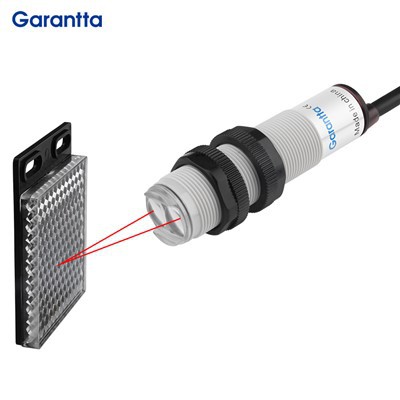
Capacitive Sensor is a non-contact sensor that uses a flat structure design and detects objects based on the principle of capacitance change. Its flat shape (usually thin, with a rectangular or square detection surface) allows it to be installed in space-constrained locations, such as equipment gaps, conveyor belt sides, etc. This structure not only saves installation space but also allows the detection surface to be closer to the target object, improving detection stability.
From the detection principle, there is a capacitor plate inside the sensor. When an object (whether metal or non-metal) approaches the detection surface, a capacitor is formed between the object and the plate, causing the capacitance value of the sensor to change. The sensor determines whether an object exists by detecting this capacitance change, and then outputs the corresponding switch signal.
In terms of output type, Flat Capacitive Sensors are also divided into NPN and PNP, which are adapted to different control system input types. Its detection distance is usually adjustable, and users can set the appropriate detection range through the knob or switch on the sensor according to actual needs to avoid false triggering.
Features
1. Stable performance, wide application range, economical, and durable
2. Sensitive response, built-in intelligent sensor chip, fast frequency response, strong anti-interference, and reliable performance
3. Excellent wire, strong and durable, using standard PVC cable with good conductivity. All indicators have passed strict reliability tests, and the wire length can be customized.
4. Garantta Flat Capacitive Sensor with sturdy shell, reliable quality, shell material ABS, neat appearance, solid and reliable, corrosion-resistant, long product service life

Advantages
1. Good temperature stability
The capacitance value of capacitive sensors is generally independent of the electrode material, which is advantageous for selecting materials with low temperature coefficients. However, due to its minimal heat generation, it has little impact on stability. And the resistance sensor has copper damage, which can easily generate heat and zero drift.
2. Simple structure
Capacitive Proximity Sensor have a simple structure, are easy to manufacture, and ensure high accuracy. They can be made very compact to achieve certain special measurements; Capable of working in harsh environments such as high temperature, strong radiation, and strong magnetic fields, able to withstand significant temperature changes, high pressure, high impact, overload, etc; It can measure ultra-high temperature and low pressure difference, as well as measure magnetic work.
3. Good dynamic response
Inductive sensors require very little energy due to the small electrostatic attraction between charged plates, and their movable parts can be made very small and thin, resulting in a lightweight design. Therefore, their natural frequency is high, their dynamic response time is short, and they can operate at frequencies of several megahertz, making them particularly suitable for dynamic measurement. Due to its low dielectric loss, it can be powered at higher frequencies, resulting in a high operating frequency of the system. It can be used to measure parameters that vary rapidly.
4. Can be measured non-contact and has high sensitivity
Non-contact measurement of vibration or eccentricity of rotating shafts, radial clearance of small ball bearings, etc. When non-contact measurement is used, flat capacitive sensors have an averaging effect, which can reduce the influence of workpiece surface roughness and other factors on the measurement.
FAQ
Q: What are the main advantages of flat capacitive proximity sensors compared to standard cylindrical sensors?
The main advantage of flat capacitive proximity sensors lies in their ultra-thin design, making them ideal for applications with limited installation space. Due to their large and uniform sensing surface, they are more sensitive and stable when detecting large objects (such as stacks of paper, wooden boards, or liquid containers). Furthermore, the flat structure typically offers a wider sensing range and is less susceptible to mechanical vibrations, making it suitable for surface mounting or embedded installation.
Q: When selecting a sensor, how do I determine whether I need a capacitive or inductive proximity sensor?
This is the most crucial selection question. The core difference lies in the object being detected:
Capacitive sensors: Can detect almost all objects (metals, non-metals, liquids, powders, and the human body). If you need to detect plastic bottles, glass plates, cardboard boxes, wood, liquid levels, or granular materials, you should choose a capacitive sensor.
Inductive sensors: Can only detect metal objects. For metal detection, they are usually more accurate and stable, and are virtually unaffected by non-metallic interfering substances (such as moisture and dust).
Simple rule: Only detecting metal → choose inductive; detecting non-metals or multiple materials → choose capacitive. Flat capacitive sensors, due to their large sensing surface, are particularly suitable for detecting large non-metallic objects or for detection through container walls.
Q:Can proximity capacitive sensors be used for liquid level detection in containers in the food or chemical industries? What are the special requirements?
Yes, this is one of its advantageous application scenarios. It can detect the presence/level of liquids or materials inside non-metallic containers (such as plastic or glass jars) through the container wall.
Special requirements:
Material compatibility: The material of the sensor's sensing surface (usually PBT or stainless steel) must be resistant to cleaning agents, corrosive liquids, or food splashes in the field. Its protection rating (IP rating) must be confirmed.
Container wall thickness: The container wall thickness must be within the sensor's "penetration capability." Different models have different penetration capabilities; please refer to the specifications. Excessive wall thickness will result in inability to detect or extremely low sensitivity.
Installation and fixing: The sensor must be tightly and evenly attached to the outer wall of the container, without any air gaps. Corrosion-resistant mounting brackets or adhesives are usually required for fixing, and the outer surface of the container wall must be clean and flat.
Hot Tags: flat capacitive sensor, China flat capacitive sensor manufacturers, suppliers, factory, Capacitive Inductive Sensor, capacitive proximity sensor for office furniture, capacitive proximity sensor for binding machines, capacitive proximity sensor for waste management, Flat Capacitive Sensor, capacitive proximity sensor for energy storage systems
flat capacitive sensor
| Model | NPN NO | GPC-16A8NO | GPC-20A10NO | GPC-30A08NO |
| NPN NC | GPC-16A8NC | GPC-20A10NC | GPC-30A08NC | |
| PNP NO | GPC-16A8PO | GPC-20410pC | GPC-30A08PO | |
| PNP NC | GPC-16A8PC | GPC-20A10PC | GPC-30A08PC | |
| Detection surface | Upper end induction | Upper end induction | Upper end induction | |
| Detection distance | 2~8mm adjustable | 2~10mm adjustable | 2~8mm adjustable | |
| Set distance | 0~6.4mm | 0~8mm | 0~6.4mm | |
| Standard detection object (iron) | 18x8x1 mm | 20x20x1mm | 30x30x1mm | |
| Detect objects | Metal objects, non-metallic substances (plastic, glass, water, oil and other non-metallic materials) | |||
| Response frequency | 100Hz | |||
| Differential frequency | Less than 10% of the detection distance | |||
| Supply voltage | 10~30V DC pulsation (P-P)10%max | |||
| Leakage current | 0.8mA Below | |||
| Switch capacity | 100mA | |||
| Control output | Load current is less than 200mA (residual constant voltage is less than 1V) | |||
| Ambient temperature | When operating: -25~+70°C When storing: -40~+85° (no freezing) | |||
| Ambient humidity | During operation and saving: 35~95%RH | |||
| Protection level | IP67 | |||