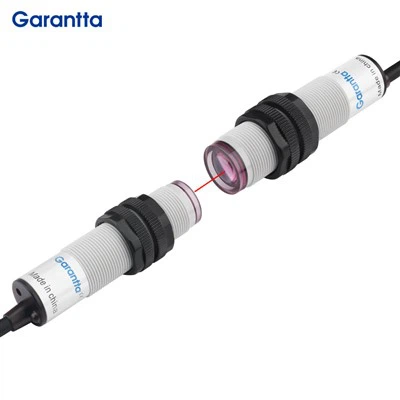
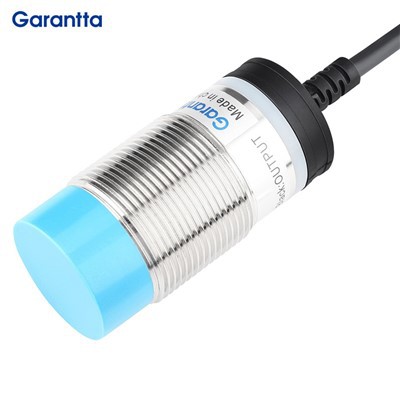
Single and double sheet ultrasonic proximity sensor are used to automatically distinguish between single and double sheets, protecting equipment and preventing waste.
Ultrasonic point sensors are primarily used for packaging or label positioning, enabling automatic and accurate automated control.
Learning Methods
Learning Mode: The pink wire is the learning wire. Leave the pink wire floating during learning mode.
1. After powering on, the yellow and green lights will flash.
Place a sheet of material between the two sensors. The green light will flash. Short the pink wire to the blue wire (GND) briefly, then release it. The green light will turn solid. Single-sheet learning is now complete.
2. Then, place two sheets of material between the ultrasonic proximity sensor and short the brown wire (+) with the pink wire to switch to dual-sheet learning mode. The indicator light will flash red. Short the pink wire to the blue wire (GND) briefly, then release it. The red light will turn solid, indicating dual-sheet learning is complete.
3. After learning is complete, turn off the power.
Connect the pink wire and the blue wire (GND) together. Re-energize the power supply and normal operation will resume.
4. In learning mode, when entering the single-sheet learning step, if the material placed is too thick and exceeds the sensor's detection range, the indicator light will flash red after placing the single sheet of material before shorting the blue wire (GND). In learning mode, during the single-sheet learning step, if the material is too thin, the sensor will not detect it. Before shorting the blue wire (GND), the indicator light will flash yellow after inserting a single sheet.


Applications
1) Ultrasonic sensors can detect the state of confined spaces. Installed on the top of a container, for example, they emit sound waves into the space, allowing the sensor to determine whether the container is full or empty.
2) Ultrasonic sensors can detect transparent objects, liquids, and any dense materials or irregular shapes, whether rough or smooth. However, ultrasonic sensors are not suitable for outdoor use, extreme heat, or other environments such as pressure tanks.
3) Ultrasonic Proximity Sensor can be used to detect liquid levels, transparent objects, and materials. Ultrasonic positioning is also used in processes such as packaging and material transportation. Therefore, ultrasonic sensors can be used to improve product quality and detect defects.


FAQ
Advantages and Disadvantages of Ultrasonic Proximity Sensor
Advantages:
1. Non-contact Sensing: Ultrasonic sensors can detect objects without physical contact, making them ideal for applications where contact could damage the sensor or the object being measured.
2. Wide Sensing Range: Ultrasonic sensors can detect objects from a few centimeters to several meters away, depending on the sensor design and application.
3. Accuracy: Ultrasonic sensors can provide accurate distance and position measurements, even in low-light or dusty environments.
4. Versatile: Ultrasonic sensors can be used in a wide range of applications, including manufacturing, robotics, automotive, and security systems.
Disadvantages:
1. Susceptibility to Interference: Ultrasonic sensors can be affected by environmental noise, vibration, and temperature changes, which can affect measurement accuracy.
2. Limited Detection Angle: Ultrasonic sensors have a limited detection angle, which can result in blind spots or missed objects if the sensor is not positioned correctly.
3. Limited Resolution: Ultrasonic sensors generally have lower resolution than other sensor types, which can limit their ability to detect small objects or changes in distance.
4. Cost: which is more expensive than other sensor types, especially for high-precision applications.
Hot Tags: ultrasonic proximity sensor, China ultrasonic proximity sensor manufacturers, suppliers, factory, ultrasonic sensor for parking systems, ultrasonic sensor for warehousing applications, ultrasonic sensor for livestock monitoring, ultrasonic sensor for veterinary applications, ultrasonic sensor for logistics applications, ultrasonic sensor for door control applications