Fiber Optic Sensor Cable

Fiber Optic Sensor Cable
Details:
1. Robust and durable high-quality materials: Utilizing high-purity glass fiber or bend-resistant polymer fiber cores, combining flexibility with ultra-high strength, significantly extending service life

2. Excellent anti-interference and environmental resistance: Signals are transmitted in the form of light within the fiber, completely immune to electromagnetic waves and radio frequency interference

3. Ultimate flexibility and miniaturization: The thin and flexible cable can be bent at large angles

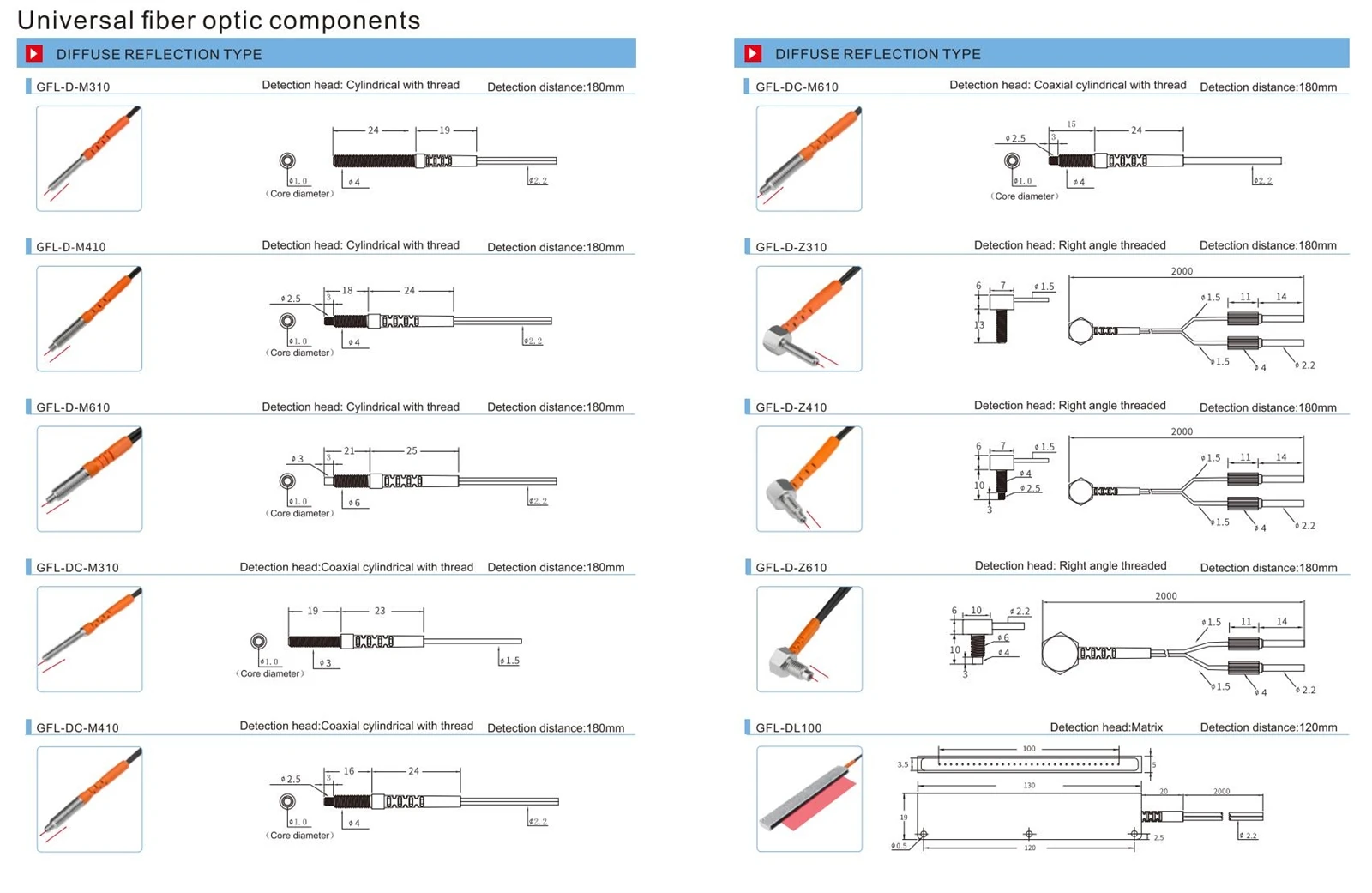
4. Rich form factors and interface options: Offering various probe forms such as threaded, straight, and right-angle, as well as standard and customized lengths, to meet diverse installation needs
Send Inquiry
Download
Description
Technical Parameters
Size & Wiring

Fiber optic cable can be divided, coaxial, or parallel (ordinary), each with its own unique shape and characteristics. The characteristic of the separated fiber optic cable is that it is divided into two parts: the light emitting part and the light receiving part, using glass fiber optic material, suitable for detecting printed marks, etc; The characteristic of coaxial fiber optic cable is that it is divided into a thicker emitting part in the middle and a smaller receiving part around it. Its special performance ignores the direction of motion of the detected object and can detect objects at the same time; The characteristic of parallel (ordinary) fiber optic cables is that they are only used for plastic fiber optic cables, and the construction method of parallel light emitting and receiving parts has a price advantage.


Features of fiber Optic Sensor Cable


1. Fiber optic cables must be equipped with amplifiers for use

2. High reliability, good stability, low signal loss, wear resistance, and corrosion resistance

3. Sturdy, durable, resistant to pressure and aging

4. The head is made of stainless steel material with high strength, sturdy and durable

5. Long term use in humid environments, corrosion-resistant and rust resistant

6. Good transparency and low transmission loss

7. High transparency plastic fiber optic core with stable signal transmission and low loss

8. Resilience and resistance to breakage

9. 1-year warranty and worry free after-sales service

10. If there are any quality problems within one year, we guarantee replacement to ensure your peace of mind and comfort


FAQ


Q: How to cut off the fiber optic sensor cable?

A: As an important component of fiber optic sensors, fiber optic cables may also need to be cut during use. Because the length of the cable provided by the brand is fixed, users will choose the appropriate length when placing an order. However, in actual use, corresponding adjustments may also be needed to cut the fiber optic cable to a length that meets the on-site requirements. However, due to its special nature, there are also issues that need to be noted during the cutting process of fiber optic cables.

Cutting of fiber optic sensor cable

When cutting fiber optic cables, please insert them into the holes of the corresponding specifications and cut the appropriate length.

Please cut off the fiber optic cable at once, as uneven cutting will affect the detection distance.

The guillotine can only be used once per hole.

If the cut surface is not ideal after cutting, the hole needs to be replaced before cutting.

Please use a specialized fiber optic cutter and do not use pliers, stationery pliers (scissors, tool knives, etc.) or other tools to cut the fiber optic cable.


Hot Tags: fiber optic sensor cable, China fiber optic sensor cable manufacturers, suppliers, factory, optical fiber sensor types, laser alignment sensor, fiber optic motion sensor, inductive type proximity sensor, M18 Photoelectric Sensor, capacitive photoelectric sensor

fibersensor cable-1

fibersensor cable-2

fibersensor cable-3

fibersensor cable-4

fibersensor cable-5

Send Inquiry