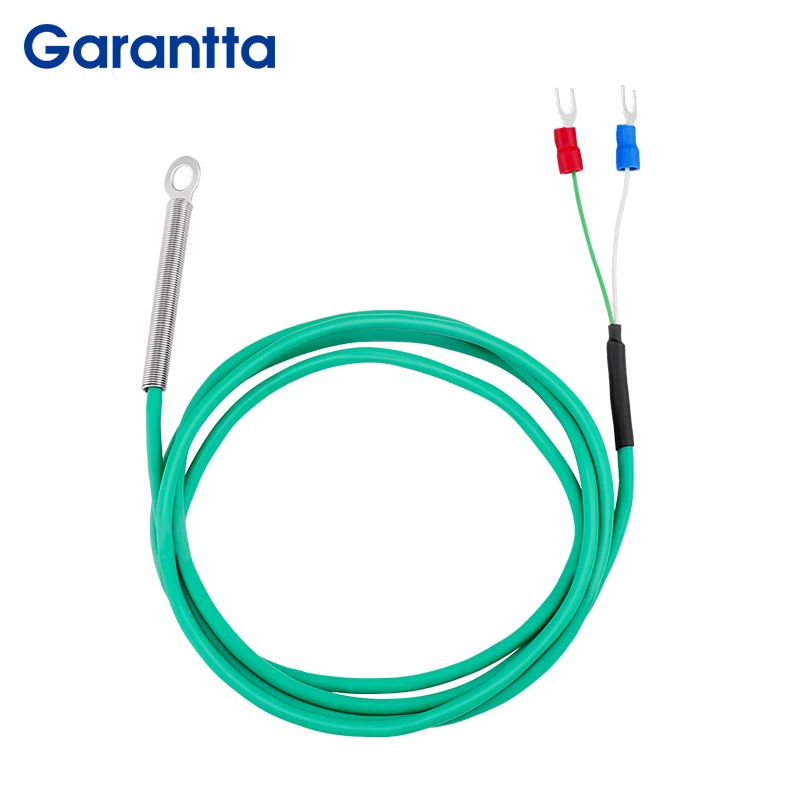
The temperature measurement principle of a Needle Thermocouple Probe is based on the Seebeck effect. It consists of two different metal conductors (usually nickel-chromium and nickel-silicon) welded together at one end to form the "measuring junction" (hot junction), while the other end remains open or connected to an instrument to form the "reference junction" (cold junction). When there is a temperature difference between the measuring junction and the reference junction, a weak voltage (thermoelectric potential) proportional to the temperature difference is generated in the circuit. By measuring this voltage, the temperature at the measuring junction can be calculated.
Advantages
1. Rugged and durable: Thermocouples are durable devices with good resistance to shock and vibration, and are suitable for dangerous and harsh environments.
2. Fast response: Because of their small size and low heat capacity, thermocouples respond quickly to temperature changes, especially when the sensing junction is exposed. They react to temperature changes within hundreds of milliseconds.
3. No self-heating: Since the Needle Thermocouple Probe does not require an excitation power source, it is not prone to self-heating and is inherently safe.


FAQ
Q: What are the common types of probes for Needle Thermocouple Probe? How should I choose one based on the application scenario?
A: The style and material of the probe are key selection factors, mainly depending on the measured medium, temperature range, and environment.
By material and protective tube:
Stainless steel (e.g., 304, 316L): Most commonly used, suitable for most liquids, gases, and mildly corrosive environments, with a temperature limit of approximately 900°C.
High-temperature stainless steel/Inconel alloy: Used for higher temperatures (e.g., above 1200°C) or strongly oxidizing environments.
With anti-corrosion coating (e.g., PTFE/Teflon): Suitable for highly corrosive liquids such as strong acids and bases.
By probe shape and installation method:
Straight probe: General purpose, used for insertion into liquids, air, or pipes.
Bent/right-angle probe: Convenient for installation in confined spaces or specific directions.
Threaded installation type: Fixed to equipment or pipes via threads (e.g., M6, G1/2"), providing good sealing and preventing detachment.
With mounting flange type: Used for large tanks or pipes requiring secure fixing and good sealing.
Selection suggestions:
Measuring liquids/insertion depth: Choose a straight probe of sufficient length, with a corrosion-resistant material.
Measuring pipe gas/steam: Prioritize models with threads or flanges to ensure sealing.
Measuring surfaces or confined spaces: Bent or pointed probes can be used.
High-frequency response requirements: Choose armored, small-diameter, pointed probes.
Q: What causes the temperature value of the Needle Thermocouple Probe indexing meter to jump randomly?
2. The measuring line is damaged, causing intermittent circuit breakage or grounding.
3. Insufficient installation or external vibration
4. External interference
Q: Does the Needle thermocouple probe K-type indexing table correspond to the actual temperature?
If the thermocouple electromotive force is obtained when the temperature of the reference terminal is not 0°C, the millivolt value corresponding to the temperature of the reference terminal should be found out from the graduation table according to the requirements of the thermocouple intermediate temperature law, and then used to add the reference The millivolt value of the thermocouple obtained when the end temperature is not 0°C, and finally the corresponding working end temperature is found in the graduation table using the added result.
This process of using the thermocouple intermediate temperature law is the process of thermocouple cold-end temperature compensation.
Hot Tags: needle thermocouple probe, China needle thermocouple probe manufacturers, suppliers, factory, Stainless Steel Thermocouple, Needle Thermocouple Probe, temperature sensor for boiler equipment, Silicone K type thermocouple, temperature sensor for torque monitoring, temperature sensor for retrieving
K-type thermocouple specifications
| Model | Products Name | Wire material | Line skin | Wire diameter (MM) |
Wire core specifications | length (MM) |
Graduation mark | Actual application temperature (℃) |
thermal conductor | Thermal conductor material | Thermal conductor size (MM) |
Nut material | Thread | Nut size | Connection terminal | Connection terminal size (MM) |
Spring material | Spring size (outer diameter * length MM) |
Insulated/non-insulated |
| TS-L0530-05 | Probe type K-type thermocouple | KX nickel chromium nickel silicon | stainless steel braided | 2*3 | 7*0.2 | 500 | K | 0-250 | Head pipe | 304 stainless steel | 5*0.3*30 | Red and blue SV fork | 20*6.5/4.3*0.5 | non-insulated | |||||
| TS-L0530-10 | Probe type K-type thermocouple | KX nickel chromium nickel silicon | stainless steel braided | 2*3 | 7*0.2 | 1000 | K | 0-250 | Head pipe | 304 stainless steel | 5*0.3*30 | Red and blue SV fork | 20*6.5/4.3*0.5 | non-insulated | |||||
| TS-L0530-15 | Probe type K-type thermocouple | KX nickel chromium nickel silicon | stainless steel braided | 2*3 | 7*0.2 | 1500 | K | 0-250 | Head pipe | 304 stainless steel | 5*0.3*30 | Red and blue SV fork | 20*6.5/4.3*0.5 | non-insulated | |||||
| TS-L0530-20 | Probe type K-type thermocouple | KX nickel chromium nickel silicon | stainless steel braided | 2*3 | 7*0.2 | 2000 | K | 0-250 | Head pipe | 304 stainless steel | 5*0.3*30 | Red and blue SV fork | 20*6.5/4.3*0.5 | non-insulated | |||||
| TS-L0540-05 | Probe type K-type thermocouple | KX nickel chromium nickel silicon | stainless steel braided | 2*3 | 7*0.2 | 500 | K | 0-250 | Head pipe | 304 stainless steel | 5*0.3*40 | Red and blue SV fork | 20*6.5/4.3*0.5 | non-insulated | |||||
| TS-L0540-10 | Probe type K-type thermocouple | KX nickel chromium nickel silicon | stainless steel braided | 2*3 | 7*0.2 | 1000 | K | 0-250 | Head pipe | 304 stainless steel | 5*0.3*40 | Red and blue SV fork | 20*6.5/4.3*0.5 | non-insulated | |||||
| TS-L0540-15 | Probe type K-type thermocouple | KX nickel chromium nickel silicon | stainless steel braided | 2*3 | 7*0.2 | 1500 | K | 0-250 | Head pipe | 304 stainless steel | 5*0.3*40 | Red and blue SV fork | 20*6.5/4.3*0.5 | non-insulated | |||||
| TS-L0540-20 | Probe type K-type thermocouple | KX nickel chromium nickel silicon | stainless steel braided | 2*3 | 7*0.2 | 2000 | K | 0-250 | Head pipe | 304 stainless steel | 5*0.3*40 | Red and blue SV fork | 20*6.5/4.3*0.5 | non-insulated | |||||
| TR-L0530-05 | Probe type K-type thermocouple | KX nickel chromium nickel silicon | Silica gel | 3 | 7*0.2 | 500 | K | 0-200 | Head pipe | 304 stainless steel | 5*0.3*30 | Red and blue SV fork | 20*6.5/4.3*0.5 | non-insulated | |||||
| TR-L0530-10 | Probe type K-type thermocouple | KX nickel chromium nickel silicon | Silica gel | 3 | 7*0.2 | 1000 | K | 0-200 | Head pipe | 304 stainless steel | 5*0.3*30 | Red and blue SV fork | 20*6.5/4.3*0.5 | non-insulated | |||||
| TR-L0530-15 | Probe type K-type thermocouple | KX nickel chromium nickel silicon | Silica gel | 3 | 7*0.2 | 1500 | K | 0-200 | Head pipe | 304 stainless steel | 5*0.3*30 | Red and blue SV fork | 20*6.5/4.3*0.5 | non-insulated | |||||
| TR-L0530-20 | Probe type K-type thermocouple | KX nickel chromium nickel silicon | Silica gel | 3 | 7*0.2 | 2000 | K | 0-200 | Head pipe | 304 stainless steel | 5*0.3*30 | Red and blue SV fork | 20*6.5/4.3*0.5 | non-insulated | |||||
| TR-L0540-05 | Probe type K-type thermocouple | KX nickel chromium nickel silicon | Silica gel | 3 | 7*0.2 | 500 | K | 0-200 | Head pipe | 304 stainless steel | 5*0.3*40 | Red and blue SV fork | 20*6.5/4.3*0.5 | non-insulated | |||||
| TR-L0540-10 | Probe type K-type thermocouple | KX nickel chromium nickel silicon | Silica gel | 3 | 7*0.2 | 1000 | K | 0-200 | Head pipe | 304 stainless steel | 5*0.3*40 | Red and blue SV fork | 20*6.5/4.3*0.5 | non-insulated | |||||
| TR-L0540-15 | Probe type K-type thermocouple | KX nickel chromium nickel silicon | Silica gel | 3 | 7*0.2 | 1500 | K | 0-200 | Head pipe | 304 stainless steel | 5*0.3*40 | Red and blue SV fork | 20*6.5/4.3*0.5 | non-insulated | |||||
| TR-L0540-20 | Probe type K-type thermocouple | KX nickel chromium nickel silicon | Silica gel | 3 | 7*0.2 | 2000 | K | 0-200 | Head pipe | 304 stainless steel | 5*0.3*40 | Red and blue SV fork | 20*6.5/4.3*0.5 | non-insulated |