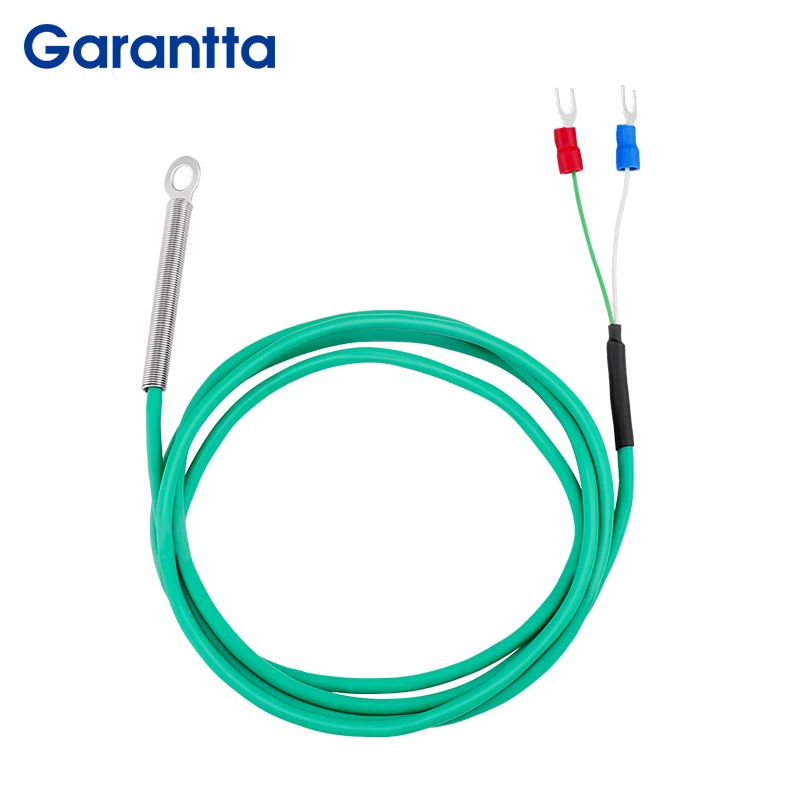
Screw Type Thermocouple

Screw Type Thermocouple
Details:
1. Utilizing a standard international M6 threaded interface, it achieves secure installation, rapid response, and convenient maintenance, making it particularly suitable for industrial equipment that is sensitive to vibration, has a compact structure, or requires surface temperature measurement
2. It can be directly screwed into threaded holes in equipment casings, pipes, or thermowells. This installation method provides a secure connection, effectively resists equipment vibration, prevents probe loosening, and usually offers good sealing, making it suitable for industrial environments with pressure or requiring dust and water resistance
3. Compared to probe-type sensors that require a certain insertion depth, the screw-in design is more suitable for measuring the temperature of solid surfaces or shallow cavities and thin-walled equipment. Its sensing point is typically located at the threaded end face or front end, occupying minimal space during installation and facilitating integration into compact equipment
Send Inquiry
Download
Description
Technical Parameters
Size & Wiring

K-type thermocouple is a kind of temperature sensor. It is usually used with display instruments, recording instruments and electronic regulators. K-type thermocouple can directly measure liquid vapor and gas medium and surface temperature in various productions from 0℃ to 250℃. K-type thermocouple is the most widely used cheap metal thermocouple at present, and its usage is the sum of other thermocouples.


As a common temperature sensor, Screw Type Thermocouple has a wide range of applications. Its main advantages include: wide measurement range, fast response speed, simple structure, ruggedness and durability, and relatively low cost


k type thermocouple -1
k type thermocouple

Main advantages of K Screw Type Thermocouple


1. K-type thermocouples can provide accurate temperature measurement over a wide temperature range, from low to high temperatures, and are suitable for a variety of application scenarios. 
2. K-type thermocouples have a small volume and low heat capacity, and respond quickly to temperature changes, especially when the sensing junction is exposed. 
3. K-type thermocouples generally have good mechanical strength and corrosion resistance, and can work reliably in harsh environments. 
4. Compared with some other types of temperature sensors, K-type thermocouples are relatively low in price and more cost-effective. 
5. K-type thermocouples are usually composed of two different metal wires, with a simple structure and easy installation and use. 


FAQ


Q: Common faults and solutions of screw type thermocouple K

A: ●  Thermocouple without thermal potential
Simply put, a thermocouple without thermal potential is a broken wire, mainly manifested as the instrument displaying the maximum value or remaining in place. At this time, it is necessary to check whether the thermocouple's internal thermocouple wire is short-circuited. A broken thermocouple wire may be caused by mechanical damage to the electrode or long-term deterioration of the thermocouple at high temperatures.
Handling method:
1. If the thermocouple wire is lost or broken, the welding point can be subtracted and re-welded. After passing the verification, it can be installed and used (the length of the thermocouple produced by re-welding will be shortened, pay attention to the change in insertion length!).
2. If the damage is severe or the thermocouple wire deteriorates, it should be replaced with a new thermocouple promptly, and the original thermocouple should be scrapped.


●  Thermocouple thermoelectric potential variation

The change in thermoelectric potential of thermocouples is mainly manifested in the discrepancy between the output signal of thermocouples and the actual value. At this point, it is necessary to check whether the length of the thermocouple insertion meets the on-site temperature measurement requirements (too long or too short); Is the installation location and method appropriate; Whether the surface of the thermocouple protection tube has accumulated scale; Check for moisture and leakage inside the thermocouple; Is there any shrinkage phenomenon in the thermocouple electrode; Thermocouples measure whether the solder joint at the measuring end is spherical, whether the surface is smooth, and whether there are any bubbles, pores, or slag inclusions; Is the k Temperature Sensor wire discolored or deteriorated.
Handling method:
1. Take out the thermocouple wire and dry the protective tube and wire separately (do not use fire to bake).
2. Check the geometric dimensions of the thermocouple with a vernier caliper, and replace any that do not meet the requirements.
3. If the screw type thermocouple K solder joints are not spherical, have uneven surfaces, have no bubbles, pores, or slag inclusions, cut off the solder joints and re-weld them. After passing the verification, they can be used.
4. If the thermocouple deteriorates or changes color, replace it with a new thermocouple for use.
5. Change the insertion length or installation position of the thermocouple to the optimal measurement requirements and firmly install it.


● The thermocouple input instrument display value is unstable

In the case where the display instrument has been verified to have no faults and the displayed value is floating, it is necessary to check whether the k type thermocouple terminal and thermocouple wire are in good contact; Whether the screw type thermocouple K is securely installed; Whether the thermocouple has any oscillation phenomenon; Is there any conductive liquid, damp dust, or metal impurities at the thermocouple joint; Whether the electrodes are grounded, short circuited, or open circuited; Whether the connection with the instrument is firm; Is the thermocouple wire seemingly broken or poorly welded.
1. Clean the thermocouple junction box, dry it, and firmly install it.
2. Re-weld the thermocouple and use it after passing the calibration.
3. Measure the resistance value of the thermocouple wire with a multimeter, and replace it if it is not qualified.
4. Identify the grounding, short circuit, or open circuit of the thermocouple compensation wire, and repair or replace it with a new compensation wire.

In addition, human faults caused by carelessness in work, such as mismatch between thermocouple graduation number and instrument, mismatch between thermocouple compensation wire and thermocouple type, reverse connection between thermocouple compensation wire and thermocouple dipole polarity, improper insertion length of thermocouple, etc., that are manifested as thermocouple output being larger or smaller than the actual value, resulting in instrument display value being higher or lower. The handling method for such faults is relatively simple, as long as the sense of responsibility of the instrument installation personnel is strengthened, the content of the instruction manual is carefully read and understood, and the thermocouple installation specifications and instrument requirements are correctly followed.


Hot Tags: screw type thermocouple, China screw type thermocouple manufacturers, suppliers, factory, Digital Color Sensor, optical fibre transducer, Small Inductive Sensor, Groove sensor, temperature probe k, ideal photoelectric sensor

K-type thermocouple specifications


Model Products Name Wire material Line skin Wire diameter
(MM)
Wire core specifications length
(MM)
Graduation mark Actual application temperature
(℃)
thermal conductor Thermal conductor material Thermal conductor size
(MM)
Nut material Thread Nut size Connection terminal Connection terminal size
(MM)
Spring material Spring size
(outer diameter * length MM)
Insulated/non-insulated
TS-M6-05 Nut type K-type thermocouple KX nickel chromium nickel silicon stainless steel braided 2*3 7*0.2 500 K 0-250 casing Nickel plated copper 4*25 Nickel plated copper M6 13.5*10*11*3.5mm Red and blue SV fork 20*6.5/4.3*0.5 spring steel 6*50 non-insulated
TS-M6-10 Nut type K-type thermocouple KX nickel chromium nickel silicon stainless steel braided 2*3 7*0.2 1000 K 0-250 casing Nickel plated copper 4*25 Nickel plated copper M6 13.5*10*11*3.5mm Red and blue SV fork 20*6.5/4.3*0.5 spring steel 6*50 non-insulated
TS-M6-15 Nut type K-type thermocouple KX nickel chromium nickel silicon stainless steel braided 2*3 7*0.2 1500 K 0-250 casing Nickel plated copper 4*25 Nickel plated copper M6 13.5*10*11*3.5mm Red and blue SV fork 20*6.5/4.3*0.5 spring steel 6*50 non-insulated
TS-M6-20 Nut type K-type thermocouple KX nickel chromium nickel silicon stainless steel braided 2*3 7*0.2 2000 K 0-250 casing Nickel plated copper 4*25 Nickel plated copper M6 13.5*10*11*3.5mm Red and blue SV fork 20*6.5/4.3*0.5 spring steel 6*50 non-insulated
TR-M6-05 Nut type K-type thermocouple KX nickel chromium nickel silicon Silica gel 3 7*0.2 500 K 0-200 casing Nickel plated copper 4*25 Nickel plated copper M6 13.5*10*11*3.5mm Red and blue SV fork 20*6.5/4.3*0.5 spring steel 6*50 non-insulated
TR-M6-10 Nut type K-type thermocouple KX nickel chromium nickel silicon Silica gel 3 7*0.2 1000 K 0-200 casing Nickel plated copper 4*25 Nickel plated copper M6 13.5*10*11*3.5mm Red and blue SV fork 20*6.5/4.3*0.5 spring steel 6*50 non-insulated
TR-M6-15 Nut type K-type thermocouple KX nickel chromium nickel silicon Silica gel 3 7*0.2 1500 K 0-200 casing Nickel plated copper 4*25 Nickel plated copper M6 13.5*10*11*3.5mm Red and blue SV fork 20*6.5/4.3*0.5 spring steel 6*50 non-insulated
TR-M6-20 Nut type K-type thermocouple KX nickel chromium nickel silicon Silica gel 3 7*0.2 2000 K 0-200 casing Nickel plated copper 4*25 Nickel plated copper M6 13.5*10*11*3.5mm Red and blue SV fork 20*6.5/4.3*0.5 spring steel 6*50 non-insulated


Send Inquiry