

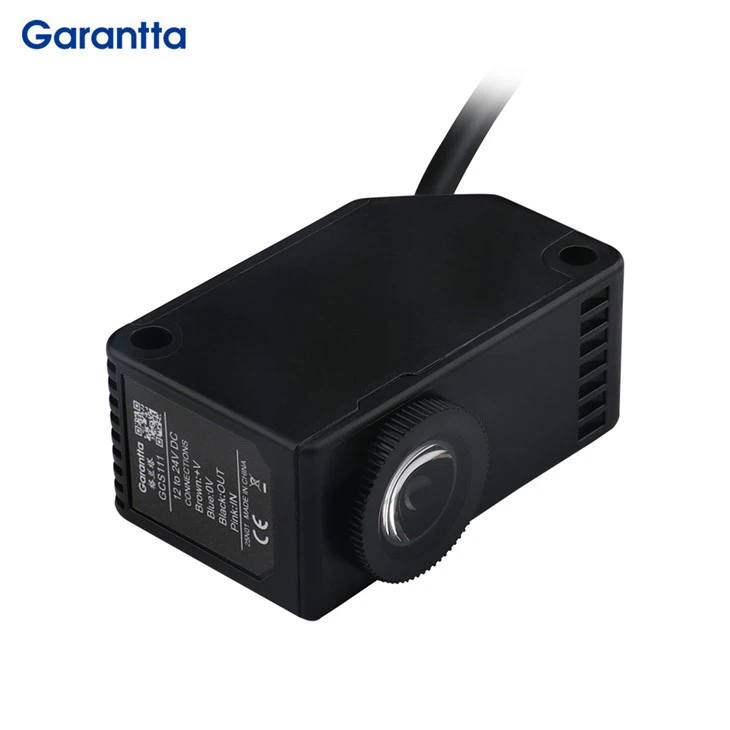


The Garantta GCS111 is a Color Recognition Sensor based on RGB three-color LED light sources, designed for high precision and ease of operation. It is widely used in production lines requiring high-precision color recognition, such as in packaging and printing. Its core detection technology utilizes RGB three-color LED light sources and a coaxial reflective optical system, providing an extremely fine detection spot of approximately 1mm × 5mm.
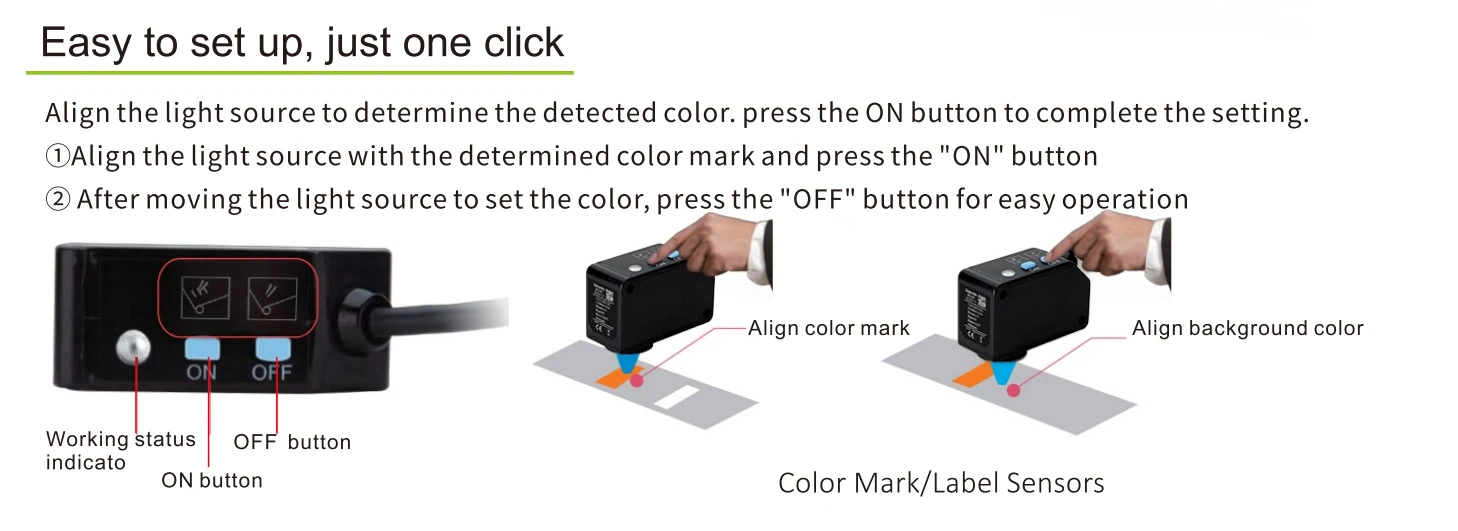
It features intelligent detection modes, including a color mark mode (ultra-high speed, 45µs) and a color mode (high precision, 150µs), and boasts an optimal automatic LED selection function. It's one-button teaching setting allows for easy learning: simply point the sensor at the color mark and press the button. With an IP67 protection rating, it is waterproof and dustproof, suitable for industrial environments from -10℃ to +55℃. Operating voltage: 12-24V DC; Output type: Available in both NPN and PNP output models; Detection distance: 10mm ±3mm.
| Quantity | Unit price (GCS111-N/GCS111-P) |
| 1-50pcs | 22.86usd/pcs |
| 50-100pcs | 21.5usd/pcs |
| ≥100pcs | 20.5usd/pcs |
Applications
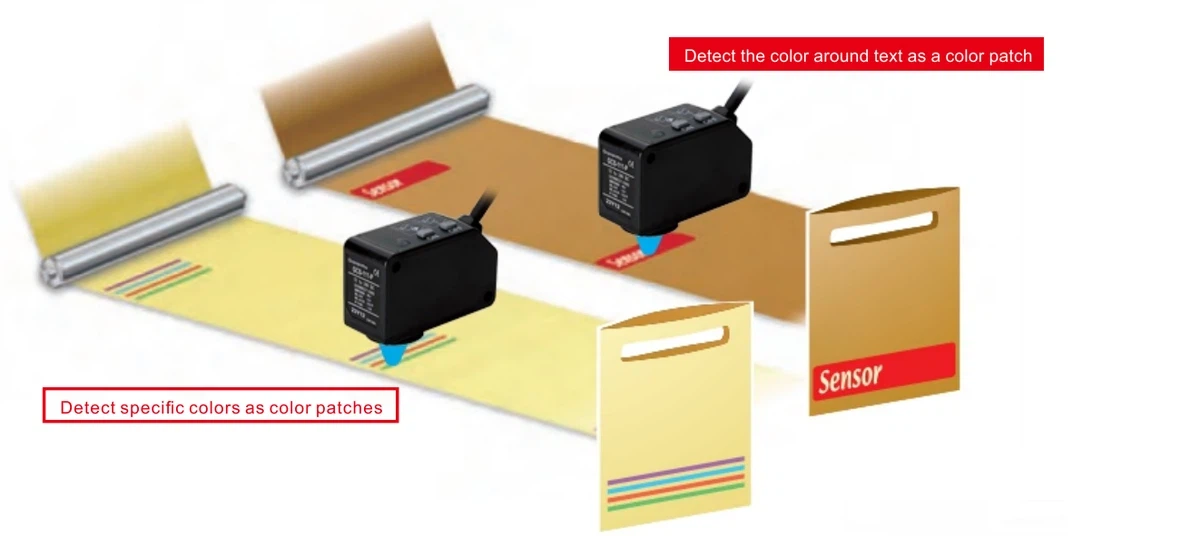
1. Cursor positioning for packaging/bag-making machines: Controls the feeding, sealing, cutting, and coding positions of packaging bags or films, ensuring that each action is performed at a fixed position on the pattern.
2. Label printing and die-cutting: Detects the printed color marks on self-adhesive labels to control the precise position of die-cutting and slitting.
3. Print registration: In multi-color printing, it detects registration marks to assist the machine in color alignment. Product sorting and classification: For example, sorting candy packaging of different flavors by color, or sorting different types of medicine packaging boxes.
4. Complex packaging inspection: Reliably identifies specific color mark areas on packaging films with colored patterns.
5. Reflective or metallic surface detection: Through a coaxial reflective optical system, it can effectively detect markings on reflective surfaces such as adhesive tape attached to metal foil.
FAQ
Q: How to perform daily maintenance and upkeep of the Mark Color Recognition Sensor GCS111?
The Mark Color Recognition Sensor GCS111 is robustly designed, and maintenance is relatively simple. Proper daily maintenance can significantly extend its service life and ensure stable detection.
Regular lens cleaning:
Importance: If the transparent lens at the front of the sensor is covered with dust, oil, or water stains, it will seriously affect light emission and reception, leading to reduced sensitivity or even malfunctions.
Method: Gently wipe with a soft, lint-free cloth (such as a lens cloth). For stubborn stains, use a cotton swab dipped in a small amount of industrial alcohol (isopropyl alcohol) to clean, then wipe dry with a dry cloth. Do not use corrosive organic solvents.
Check mounting tightness:
On equipment with continuous vibration or high-speed operation, regularly check that the screws of the sensor and its bracket are not loose, ensuring that the mounting position and detection distance have not changed.
Electrical connection check:
Regularly check the sensor's cables and connectors to ensure there is no pulling, damage, or poor contact. For connector-type models (models with "-Z"), ensure the plug is securely locked in place.
Performance verification:
After the equipment has been running for a long time or after changing product batches, if conditions permit, perform a one-button teaching process again to ensure that the sensor learns the most accurate standard signal.
Environmental management:
Although the protection rating is IP67, avoid spraying strong corrosive liquids directly onto the sensor housing. When cleaning the entire machine, be careful not to use a high-pressure water gun to directly spray the sensor.
Q: What are the key considerations and operating techniques when performing "one-touch teaching" with the Mark Color Recognition Sensor GCS111?
"One-touch teaching" is the core of the Mark Color Recognition Sensor GCS111 simplicity, but correct operating procedures are fundamental to ensuring stable subsequent detection.
Core prerequisite: Target object status:
Use "qualified samples": Ensure that the color mark or color sample used for teaching is a completely qualified, flawless standard sample. If the sample itself is flawed, the sensor will treat the erroneous information as the standard.
Maintain stability: During teaching, both the object being detected and the sensor itself must remain stationary to avoid inaccurate teaching data due to vibration or movement.
The secret to precise alignment:
Because the Mark Color Recognition Sensor GCS111 light spot is very small (1mm × 5mm), direct visual alignment may be difficult. A practical technique is to first put the sensor into detection mode (power on), then gently move it slightly back and forth and left and right above the target object, observing its output indicator light (steady on or off). The position where the indicator light changes most sensitively and stably is the best position where the light spot completely covers the target. Pressing the "teach button" at this point will be most accurate.
Mode selection first:
Before teaching, be sure to select the required "color mark mode" or "color mode" using the sensor's "MODE" button. Teaching in different modes uses different learning and comparison algorithms, directly affecting the detection effect.
Verification and fine-tuning:
After teaching is complete, be sure to verify the results. Move the sensor away, then realign it with the target object, and observe whether the indicator light responds stably and accurately. You can test several qualified and unqualified samples (or backgrounds) to confirm the effect.
If unstable detection is observed, try performing multiple teachings at different positions (e.g., the center or edge of the color mark) to allow the sensor to acquire more comprehensive data.
Hot Tags: color recognition sensor, China color recognition sensor manufacturers, suppliers, factory, color light sensor, color sensor for track and field events, color sensor for medical devices, color sensor for world cup, color sensor for tablets, color sensor for e readers
color mark sensor
| Model | NPN NO GCS-111 | |||
| PNP NO GCS-111-P | ||||
| Type | Cable type | |||
| Detection distance | 10±3.5mm | |||
| Spot size | 1x5mm(Set distance: 10 mm) | |||
| Supply voltage | 12~24VDC±10%/pulsation P-P 10% or less | |||
| Power consumption | Power 850mW or less (power supply voltage 24V, current consumption 30mA or less) | |||
| Cut-in mode | ||||
| Color mark mode | Color mode | |||
| Low..0~+2V (source current below 0.5mA) | High...+5V~-+V (inflow current is less than 3mA) | |||
| Input impedance is about 10KQ | Input impedance is about 10KO | |||
| Color mode | Color mode | |||
| High..+5V~-+V or disconnected | Low...0~+0.6V or disconnected | |||
| Output | ||||
| NPN open collector transistor | PNP open collector transistor | |||
| Maximum source current: 50mA | Maximum source current: 50mA | |||
| Applied voltage: 30V DC or less (between output and +V) | Applied voltage: 30V DC or less (between output and +V) | |||
| Residual voltage: 1.5V or less (when the outflow current is 50mA) (Note 1) | Residual voltage: 1.5V or less (when the outflow current is 50mA) (Note 1) | |||
| Output action | Color mark mode: ON when light enters, Color mode: ON when consistent | |||
| Short circuit protection | Equipped (automatic reset type) | |||
| Reaction time | Color mark mode: 45μs or less, color mode: 150μs or less | |||
| Working status indicator light | Orange LED (lights up when output is ON) | |||
| Ambient temperature | 10~+55℃ (note no condensation or freezing) during storage: -20~+70℃ | |||
| Ambient humidity | 35~85%RH, storage: 35~85%RH | |||
| Light emitting components | Red/green/blue composite LED (projection peak wavelength: 640nm/525nm/470nm) | |||
| Protective structure | IP 67(IEC) | |||


