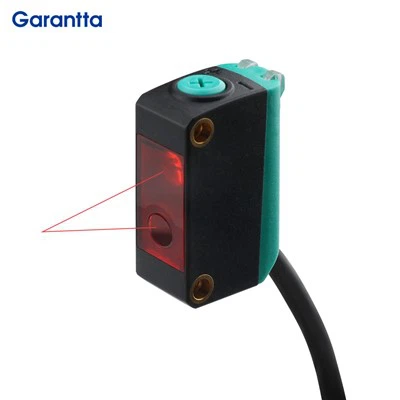
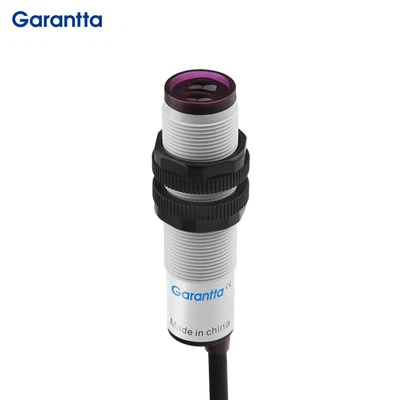
Laser displacement sensor is a laser triangulation sensor that uses laser technology for measurement. It consists of a laser, a laser detector, and a measuring circuit. Laser sensor is a new type of measuring instrument. It can accurately measure the position, displacement, and other changes of the measured object without contact.
It can measure precise geometric measurements, such as displacement, thickness, vibration, distance, and diameter. Laser has the excellent characteristic of good straightness. Similarly, laser displacement sensor has higher accuracy than the ultrasonic sensor we know. However, the laser generating device is relatively complex and large, so it will have more stringent requirements on the application range of the laser triangulation sensor.
Features
- High precision, high speed, high sensitivity, capturing tiny displacements;
- Adopting optical base die-casting parts to effectively avoid measurement errors caused by base deflection;
- Adopting a high-performance OLED display panel to support simultaneous display of data and light-receiving waveform;
- Effectively prevent water droplets, dust, and other pollutants from entering, and be strong and durable.


applications
Laser Triangulation Sensor are often used to measure physical quantities such as length, distance, vibration, speed, and orientation.
1. Dimension determination: position identification of tiny parts; monitoring of parts on the conveyor belt; detection of material overlap and coverage; control of manipulator position (tool center position); device state detection; device position detection (through small holes); liquid level monitoring; thickness measurement; vibration analysis; collision test measurement; automobile-related tests, etc.
2. Thickness measurement of metal sheets and thin plates: Laser sensors measure the thickness of metal sheets (thin plates). Detection of thickness changes can help detect wrinkles, small holes, or overlaps to avoid machine failures.
3. Cylinder barrel measurement, while measuring: angle, length, eccentricity of inner and outer diameters, conicity, concentricity, and surface profile.
4. Length measurement: Place the component to be measured on the conveyor belt at the specified position, the laser sensor detects the component and measures it simultaneously with the triggered laser scanner, and finally obtains the length of the component.


5. Check uniformity: Place several laser sensors in a row in the tilt direction of the workpiece to be measured, and output the measurement value directly through a sensor. Alternatively, you can use software to calculate the measurement value and read the result based on the signal or data.
6. Check electronic components: Use two laser scanners to place the component to be measured between the two, and finally read the data through the sensor to detect the accuracy and integrity of the component size.
7. Check the filling level on the production line: Laser sensors are integrated into the production and manufacturing of filled products. When the filled product passes through the sensor, it can detect whether it is full. The sensor uses the extended program of the laser beam reflection surface to accurately identify whether the filled product is filled properly and the number of products.
8. Sensors measure the straightness of objects: First, you need 2-3 laser triangulation sensors for combined measurement. Then, install the three laser displacement sensors on a straight line parallel to the production line, and determine the spacing between the three laser displacement sensors according to the measurement accuracy you need. Finally, you need to make this object move in a direction parallel to the installation line of the laser displacement sensor. When the production line is parallel to the installation line of the sensor, the greater the difference in the distances measured by the three sensors, the worse the straightness of the object; the smaller the difference in the distances measured by the three sensors, the better the straightness of the object. You can establish a straightness percentage based on the length of the object you want to measure and the spacing between the three sensors, thereby obtaining a quantitative signal output to achieve the purpose of detecting the straightness of the object.
FAQ
Hot Tags: laser triangulation sensor, China laser triangulation sensor manufacturers, suppliers, factory, laser 3d printing sensor, laser inspection sensor, Laser Reflective Sensor, laser calibration sensor, pole mounted laser sensor, diffused beam laser sensor