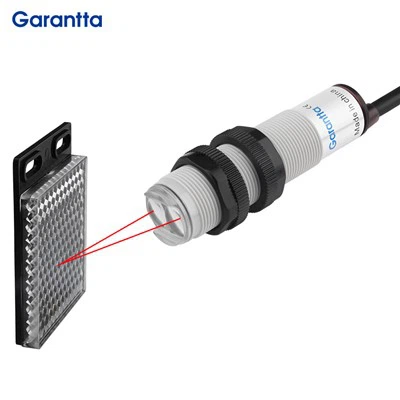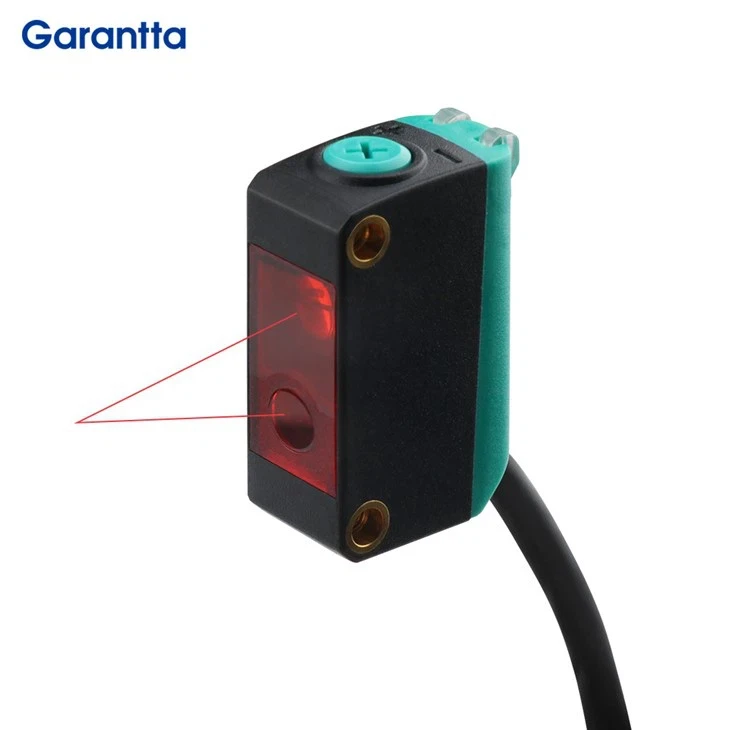
Garantta Photoelectric Laser Sensor and Reflector are types of sensors used to detect objects based on photoelectric retroreflection characteristics. Photoelectric sensors are made of an emitter light and a receiver element. The sensor can detect the interruption to a reflected light beam and decide if an object is present or not. It can replace Omron's E3Z series general-purpose photoelectric sensors.
Retroreflective sensors have both the emitter and the receiver built into the same housing. A separate reflector unit is placed to reflect the beam back to the sensor. When an object enters the region between the reflector and the sensor, it obstructs the light beam. This interruption causes the light beam to diffuse, and the sensor detects the change. It then causes the output to change.
Features
1.Laser Sensor and Reflector uses lasers instead of LEDs.
Compared to LED sensors, laser sensors are easier to align, have higher accuracy, and can detect smaller objects and smaller gaps.
2.Retroreflective photoelectric sensors simplify installation.
Through-beam sensors are typically used to detect small, brightly lit targets. While through-beam detection is relatively reliable, it requires separate wiring and power supply for the transmitter and receiver, as well as installation and alignment. Retroreflective sensors eliminate the need for wiring and powering on both sides. Installation and alignment are also simpler and more convenient than through-beam sensors, saving time and wiring costs.
3.Precision optical design with a dedicated chip, easy to detect various targets;
4.With short circuit protection and reverse polarity protection function


| Parameter categories | Garantta GPS-LR61 / LR81 | OMRON E3Z-LR61 / LR81 (equivalent model) |
| Detection method | Specular reflection/retroreflective | Specular reflection/retroreflective |
| Detection distance | 30mm ~ 8000mm | The range is 0.2 to 15 meters when using different reflectors; however, it can reach 15 meters when using E39-R1. |
| Output type | Dual NPN & PNP Outputs • GPS-LR61: NPN NO • GPS-LR81: PNP NO |
Clearly categorized into NPN and PNP models: • E3Z-LR61: NPN output • E3Z-LR81: PNP output |
| Response time | ≤1 ms |
≤0.5 ms |
| power supply voltage | Wavelength: 655nm red LD Laser Class: Class 1 |
|
| Light source/laser grade | 10-30 VDC | 12-24 VDC ±10% |
| Protection rating (IP) | IP67, with oil mist resistance.IP67, with oil mist resistance. | |
| Price | ≤$26.9 | ≈$155.31 |
Working principle
Its core operating logic is based on a sophisticated "transmit-reflect-receive" triangular closed loop:
Directional transmission: The switch's built-in projector emits a modulated, narrow beam of light at a specific wavelength (usually infrared light).
Efficient reflection: The light beam travels through the detection area and reaches a dedicated reflector (retroreflector) mounted remotely. This reflector utilizes a unique microprism array or glass bead structure to accurately reflect the incident light back along its original path with extremely high efficiency.
Precise reception: The Laser Sensor and Reflector's light receiver precisely captures this reflected light signal.
Intelligent detection: When an object under test enters the optical path and blocks the beam, the reflected light signal is interrupted or significantly weakened. Based on this information, the internal circuitry reliably outputs a switch signal (on/off state change).
FAQ
Q: What are the key considerations when installing and using a small Sensor and Reflector?
To ensure long-term stable and reliable operation of the sensor, please pay attention to the following points:
1. Safety First - Laser Safety:
Most industrial small laser sensors are Class 2 products with low output power, but it is strictly forbidden to look directly at the laser beam or view it through optical instruments (such as microscopes, telescopes) to avoid eye damage. The equipment should have clear laser safety markings.
2. Precise Installation and Calibration:
Secure installation: Use a bracket to firmly secure the sensor, preventing vibration from causing optical axis misalignment.
Precise alignment: For through-beam and retroreflective types, be sure to use the laser spot to align the transmitter and receiver (or reflector) precisely. Even slight misalignment can cause significant signal attenuation.
Avoid light interference: Although highly resistant to interference, try to avoid the sensor facing strong light sources (such as the sun, high-power lamps). In retroreflective applications, ensure that there are no strong reflective objects in the background.
3. Consider the Characteristics of the Object Being Measured:
For diffuse reflection types, the influence of the object's color, material, and surface finish on the detection distance must be evaluated in advance, and sufficient sensitivity margin should be allowed. For transparent or highly reflective (such as mirrored) objects, a special model or adjustment of the installation angle is required.
4. Environmental Resistance:
Ensure that the Sensor and Reflector protection rating (IP rating) meets the on-site environmental requirements (such as dustproof, waterproof, and oilproof).
Note the operating temperature range and avoid using it at extreme temperatures.
Keep away from strong electromagnetic interference sources.
5. Regular Maintenance:
Regularly clean dust and oil from the lens surface to avoid affecting the optical path. Use a soft cloth and special lens cleaner for cleaning.
Regularly check whether the optical path is accidentally blocked or misaligned.
Hot Tags: sensor and reflector, China sensor and reflector manufacturers, suppliers, factory, laser hydroelectric sensor, laser road construction sensor, surveying laser sensor, diffuse beam sensor, types of laser sensors, connected laser sensor