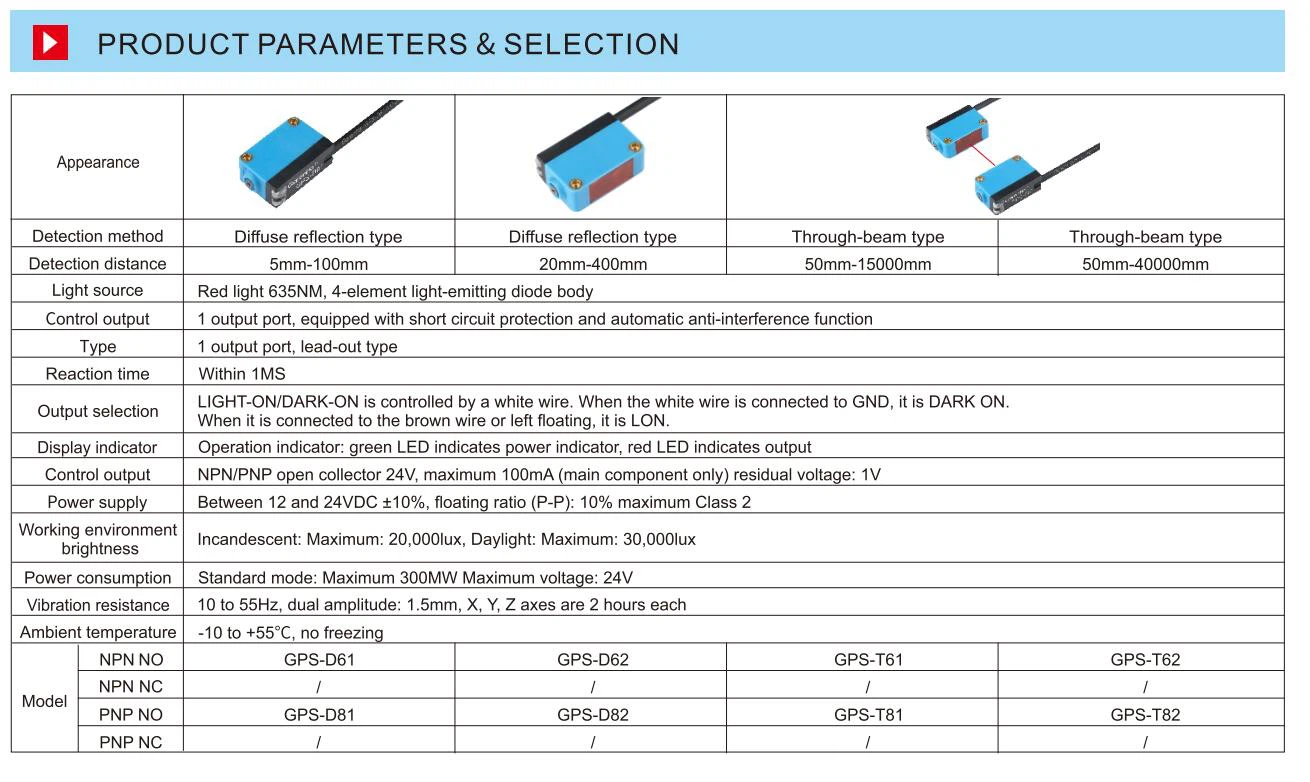
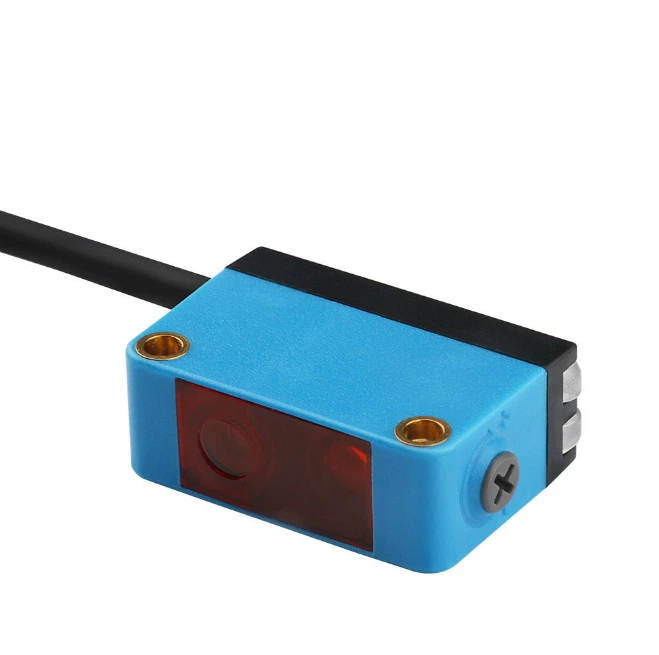
Diffuse Reflective Photoelectric Sensor integrate a transmitter and receiver. Under normal circumstances, the receiver cannot receive the light signal from the transmitter. When the object enters the detection range, the emitted light strikes its surface, creating a diffuse reflection effect. Some of the light is reflected back, and the receiver receives the light signal and outputs a switch control signal. Diffuse reflection photoelectric sensors have a distance adjustment function. In industrial control sites and other applications, distance adjustment is required to determine the detection range. This is achieved by adjusting the sensitivity of the receiver to change the detection distance.
Working Principle: A photoelectric switch (photoelectric sensor), short for photoelectric proximity switch, detects the presence of an object by blocking or reflecting a light beam. This is accomplished by activating a synchronous circuit, not just metal; any object that reflects light can be detected. The photoelectric switch converts input current into a light signal at the transmitter, which is then emitted. The receiver then detects the target object based on the intensity or presence of the received light.
features Of Diffuse Reflective Photoelectric Sensor
- Reliability: Featuring one-piece injection molding, IP67-rated protection, and a mortise-and-tenon structure, this product offers superior sealing, making it resistant to water mist, dust, and other harsh environmental conditions.
- Intelligence: Equipped with a stability indicator light and intelligent self-diagnosis output, it ensures optimal and stable performance with easy setup.
- Versatility: Combines both normally open and normally closed functions in one unit. Simply turn the L/D knob to switch between action modes.
- Precision: The detection distance can be finely adjusted using the sensitivity knob. Turn to MIN for shorter distances and MAX for longer ranges.
- Stability: Incorporates a unique interference avoidance algorithm, providing excellent resistance to both light and electromagnetic interference.
- Consistency: Features straightforward optical axis adjustment with minimal deviation between the optical and mechanical axes, ensuring reliable performance.
Advanges of Diffuse Reflective Photoelectric Sensor
1. Universal housing, ideal replacement for a wide range of sensor types;
2. Visible light spot, easy installation, and debugging;
3. Dual LED lights, clear identification of action
3. IP67 protection level, suitable for harsh environments;
4. Excellent quality, most competitive price
5. Equipped with an output reverse connection protection function, it can protect the sensor even if the wiring is wrong



FAQ
Differences between Through-Beam and Diffuse Reflective Photoelectric Sensor
1. Diffuse Reflective Photoelectric Sensor: This sensor combines a transmitter and receiver. When an object passes by, it reflects a sufficient amount of light from the transmitter to the receiver, generating a switch signal. Diffuse-reflection photoelectric switches are the preferred detection mode when the surface of the object being detected is shiny or has a very high reflectivity.
2. Mirror-Reflection Photoelectric Switch: This sensor also combines a transmitter and receiver. Light from the transmitter is reflected back to the receiver by a reflector. When the object passes by and completely blocks the light, the switch generates a switch signal.
3. Through-Beam Photoelectric Switch: This sensor consists of a separate transmitter and receiver with their optical axes facing each other. Light from the transmitter enters the receiver directly. When the object passes between the transmitter and receiver and blocks the light, the switch generates a switch signal. Through-Beam Photoelectric Switches are the most reliable detection devices when the object being detected is opaque. 4. Slot-type photoelectric switches: These typically utilize a standard U-shaped structure, with the transmitter and receiver located on either side of the U-shaped slot, forming an optical axis. When the object passes through the slot and blocks the optical axis, the photoelectric switch generates a switching signal. Slot-type photoelectric switches are particularly suitable for detecting high-speed moving objects and can distinguish between transparent and translucent objects, making them safe and reliable to use.
Hot Tags: diffuse reflective photoelectric sensor, China diffuse reflective photoelectric sensor manufacturers, suppliers, factory, analog photoelectric sensor, ideal photoelectric sensor, opposed photoelectric sensor, photocell beam sensor, photoelectric speed sensor, wide beam photoelectric sensor