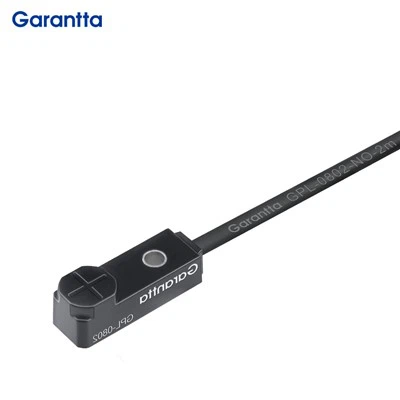
Metal detector proximity sensor also known as non-contact proximity switch, is an ideal electronic switching sensor. When the metal detector approaches the sensing area of the switch, the switch can quickly issue electrical commands without contact, pressure, or sparks, accurately reflecting the position and stroke of the motion mechanism. Even if it is used for general stroke control, its positioning accuracy and operation The frequency, service life, convenience of installation and adjustment and adaptability to harsh environments are incomparable to general mechanical limit switches. It is widely used in machine tools, metallurgy, chemical industry, textile and printing industries. It can be used as a limit, counting, positioning control and automatic protection link in the automatic control system. Proximity switches have the characteristics of long service life, reliable operation, high repeatability positioning accuracy, no mechanical wear, no sparks, no noise, and strong vibration resistance.
Main Features
- The temperature range of the product is wider, ranging from -40 degrees to 85 degrees
- Better vibration resistance, suitable for harsh environmental conditions
- Longer detection distance to meet diverse customer needs
- Wide voltage tolerance range, suitable for on-site variable voltage fluctuation conditions
- The Metal Detector Proximity Sensor cable used is made of PU material, which is resistant to oil stains, corrosion, bending, and has high tensile strength
- The product process adopts resin sealing, which improves the stability and safety of the product


Precautions for use
- Metal Detector Proximity Sensor have high sensitivity, and attention should be paid to the distance between the sensor and the object being measured during installation to avoid interference.
2. The sensor should be installed in a relatively dry and stable temperature environment to prevent its working temperature range from being affected by too high or too low.
3. Do not use metal tools to touch the sensor, otherwise it will reduce its detection accuracy and stability.
4. Sensors should be installed separately from other electronic devices to avoid electromagnetic interference affecting their working performance.

Common troubleshooting of proximity sensors
① Stable power supply provides separate power to the proximity sensor;
② The response frequency is within the rated range;
③ There is shaking during the object detection process, causing it to exceed the detection area;
④ Multiple probes are tightly installed and interfere with each other;
⑤ There are other objects being measured within the detection area around the sensor probe;
⑥ There are high-power devices and electrical interference around the proximity sensor.
Application of proximity sensors
Metal Detector Proximity Sensor can also be used as magnetic speed switches, gear and rack speed sensors, etc. These sensors are widely used in industries such as textiles, chemical fibers, machine tools, machinery, metallurgy, locomotives, and automobiles for detecting the speed and distance of chain teeth, measuring the speed of gear teeth, and controlling automotive protection systems. In addition, this type of sensor can also be used for small object detection, object spraying control, wire breakage monitoring, small part differentiation, thickness detection, and position control in the feeding pipe system.

FAQ
Q: Is the material of Metal Detector Proximity Sensor metal or non-metal?
The shell material can be metal or non-metal.
The working principle of an inductive proximity switch is to change the inductance of the coil in the oscillator, causing the oscillator to oscillate or stop oscillating. The changes are processed by the subsequent amplification circuit and converted into switch signals. The inductance of the coil plays a key role, and its shell material will affect the inductance of the coil, but as long as this influence is fixed, other parts will always match it.
Q: What is the difference between Metal Detector Proximity Sensor pnp and npn?
Proximity switches are divided into NPN output type and PNP output type. When the NPN output type is turned on, the current flows from the power supply through the sensor output terminal to the load, and then to the ground terminal. When the PNP output type is turned on, the current flows from the power supply through the load to the sensor output terminal, and then to the ground terminal.
The NPN output type signal output line is connected to GND when there is a signal and outputs a high level. When there is no signal, the NPN-NO type output line is suspended, and when there is a signal, the output line is connected to VCC and outputs a high level. When there is no signal, the NPN-NC type output line is connected to VCC, and when there is a signal, the output line is suspended.
The PNP output type signal output line is connected to VCC when there is a signal and outputs a low level. When there is no signal, the PNP-NO type output line is suspended, and when there is a signal, the output line is connected to 0V and outputs a low level. When there is no signal, the PNP-NC type output line is connected to 0V, and when there is a signal, the output line is suspended.
Two output forms are suitable for different circuit designs. Choose the appropriate output type to ensure the normal operation of the circuit.
Q: Are electromagnetic proximity switches and Metal Detector Proximity Sensor the same?
Electromagnetic proximity switches and inductive proximity switches are not the same.
1. Capacitive proximity switches are usually measured using one plate of a capacitor, with the other plate being the switch casing. When measuring, this type of casing is usually grounded or connected to the casing of the device. When an object moves to a proximity switch, regardless of whether it is a conductor or not, due to its proximity, the dielectric constant of the capacitor always changes, causing a change in capacitance and a change in the state of the circuit connected to the measuring head. The objects detected by this proximity switch are not limited to conductors, liquids, or powders, and can be insulated.
2. Electromagnetic proximity switch is one or more devices that convert magnetic signals into electrical signals. By utilizing the conversion relationship between magnetic quantities and other physical quantities, using a magnetic field as a medium, other non electric physical quantities can also be converted into electrical signals. Electromagnetic proximity switch is a type of magnetic induction sensor and non-contact position detection switch. Non contact position detection will not wear or damage the detection object, and has a fast response speed. The output states of electromagnetic proximity switches are divided into normally open, normally closed, and locked, with NPN and PNP output forms. Its wiring forms include AC, DC, double wire, three wire, four wire, five wire, etc. Usually, when using electromagnetic proximity switches, current limiting resistors and protective diodes are connected in series. Even if the polarity of the lead is reversed, it will not burn out, but the electromagnetic proximity switch cannot work properly.
Q: Classification of metal detector proximity sensor:
1. Inductive limit switch
The sensing head of the Metal Detector Proximity Sensor is a ferrite core inductor coil that can only detect metal bodies.
The oscillator generates an alternating magnetic field on the surface of the sensing head. When a metal object approaches the sensing head, the internal movement of the switch is restricted, thereby achieving "on" and "off" control.
2. Capacitive proximity switch
The sensing head of the capacitive proximity switch is a round or square plate electrode, which forms a distributed capacitance with the ground wire of the resonant circuit. If a conductor or other medium comes close to the sensing head, the capacity increases, the oscillator stops vibrating, and the electrical signal is derived through a shaping amplifier. Capacitive proximity switches can detect metals, non-metals and liquids.
3. Magnetic limit switch
The magnetic limit switch mainly refers to the Hall limit switch. Its working principle is the Hall effect. When a magnetic object approaches the Hall switch, the state of the Hall limit switch will change, such as from "on" to "off".
4. Photoelectric limit switch
Sensors made from the photoelectric effect are called photoelectric sensors. The photoelectric sensor is a non-contact control device that uses a photoreceiver composed of a photoelectric conversion element to check whether the object is large or small, and adjusts the brightness according to the light from the projector.
According to the output signal, it can be divided into analog type, digital display type and switching output type. Among them, the sensor whose derived form is a switching value is a photoelectric limit switch. It consists of a light transmitter (which emits infrared or visible light) and a light receiver (which receives light and converts it into an electrical signal, which is exported through a switch).
About Garantta
Garantta Sensor Technology (Garantta) is a high-tech enterprise specializing in sensor products. The main products include the photoelectric sensor series, fiber optic sensor series, temperature sensor series, proximity sensor series, safety light curtain sensor series, measurement sensor series, flow measurement sensor series, pressure sensor series, liquid level sensor, and composite sensor (MEMS). Products are widely used in automation equipment, medical equipment, 3C digital products, automobiles, home appliances, and other fields. From core accessories, to product strategy, and supplier management, we insist on high-quality workmanship and pursue the ultimate quality. We are not only committed to meeting the needs of many customers in the manufacturing and R&D industries but are also committed to future development and providing customers with more long-term improvements and solutions. In addition to providing excellent products and solutions, we also provide customers with richer industry knowledge and more professional technical solutions to help customers achieve higher achievements.
Company Vision
Let sensing technology benefit manufacturing and life
Company Mission
Corporate mission: Provide customers with high-quality and reliable sensor products and technical solutions to help customers achieve higher achievements

1000+
Sensor Series
10000+
Customers
200+
Agent
2000+
Projects Completed
Finding our office website in Google, check the product link you need, and contact us, send us your sensor requirements solution
Our address
Room 1007-1008, 10th Floor, Building 7, Hengda Fashion Valley, Dalang Street, Longhua New District, Shenzhen
Phone Number
+ 86 13530821762
info@garantta.com

FAQ

01.How we control the Metal Detector Proximity Sensor quality?
02.Can we accept samples customized?
03.What about the production capacity?
04.OEM and ODM are available?
05.Will the delivery time be long for a big order?
06.What is our Metal Detector Proximity Sensor warranty service?
Hot Tags: metal detector proximity sensor, China metal detector proximity sensor manufacturers, suppliers, factory, sensor for production line, inductive sensor stainless steel, proximity sensor distance measurement, inductive transducer types, ferrous metal proximity sensor, proximity electrical system sensor
Square type inductive sensor specifications
| Model | Detection distance | Set distance | Movement differential | NPN/PNP | Operating mode | Standard test substance | Supply voltage | Consumption current | Load | Residual voltage | Switching frequency | Protection circuit | Ambient temperature | Ambient humidity | Protection grade |
| GPL-0802-NO-2m | 2.5mm | 0~1.8mm | Within 10% detection distance | NPN | normally open | Mild steel (ST37) | below 10-30VDC | below 8mA | below 100mA | below 1V | 1.2KHz | Output polarity reverse protection, power supply reverse polarity protection, surge absorption, short circuit protection | -25~70℃ | 35%~95%RH | IP67 |
| GPL-0802-NC-2m | normal close | ||||||||||||||
| GPL-0902-NO-2m | normally open | ||||||||||||||
| GPL-0902-NC-2m | normal close | ||||||||||||||
| GPL-1204-NO-2m | 4mm | 0-3.2mm | NPN | normally open | 1KHz | ||||||||||
| GPL-1204-NC-2m | normal close | ||||||||||||||
| GPL-1204-PO-2m | PNP | normally open | |||||||||||||
| GPL-1204-PC-2m | normal close | ||||||||||||||
| GPL-1705-NO-2m | 5mm | 0~4mm | Within 10% detection distance | NPN | normally open | Mild steel (ST37) | below 10-30VDC | below 8mA | below 100mA | below 1V | 1KHz | Output polarity reverse protection, power supply reverse polarity protection, surge absorption, short circuit protection | -25~70℃ | 35%~95%RH | IP67 |
| GPL-1705-NC-2m | normal close | ||||||||||||||
| GPL-1705-PO-2m | PNP | normally open | |||||||||||||
| GPL-1705-PC-2m | normal close | ||||||||||||||
| GPL-1805-NO-2m | NPN | normally open | |||||||||||||
| GPL-1805-NC-2m | normal close | ||||||||||||||
| GPL-1805-PO-2m | PNP | normally open | |||||||||||||
| GPL-1805-PC-2m | normal close | ||||||||||||||
| GPL-2510-NO-2m | 10mm | 0~8mm | Within 10% detection distance | NPN | normally open | Mild steel (ST37) | below 10-30VDC | below 8mA | below 100mA | below 1V | 800Hz | Output polarity reverse protection, power supply reverse polarity protection, surge absorption, short circuit protection | -25~70℃ | 35%~95%RH | IP67 |
| GPL-2510-NC-2m | normal close | ||||||||||||||
| GPL-2510-PO-2m | PNP | normally open | |||||||||||||
| GPL-2510-PC-2m | normal close | ||||||||||||||
| GPL-3010-NO-2m | NPN | normally open | |||||||||||||
| GPL-3010-NC-2m | normal close | ||||||||||||||
| GPL-3010-PO-2m | PNP | normally open | |||||||||||||
| GPL-3010-PC-2m | normal close | ||||||||||||||
| GPL-4020-NO-2m | 20mm | 0~16mm | Within 10% detection distance | NPN | normally open | Mild steel (ST37) | below 10-30VDC | below 8mA | below 100mA | below 1V | 400Hz | Output polarity reverse protection, power supply reverse polarity protection, surge absorption, short circuit protection | -25~70℃ | 35%~95%RH | IP67 |
| GPL-4020-NC-2m | normal close | ||||||||||||||
| GPL-4020-PO-2m | PNP | normally open | |||||||||||||
| GPL-4020-PC-2m | normal close |