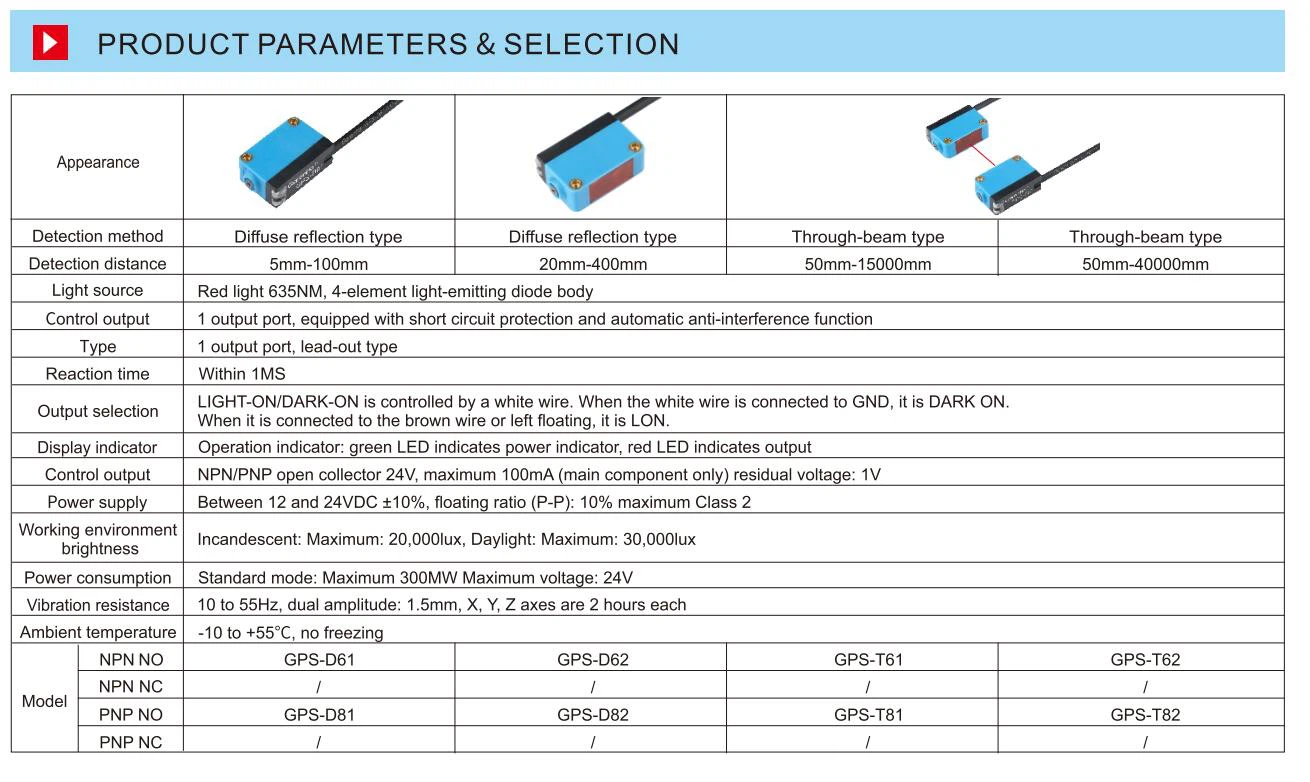
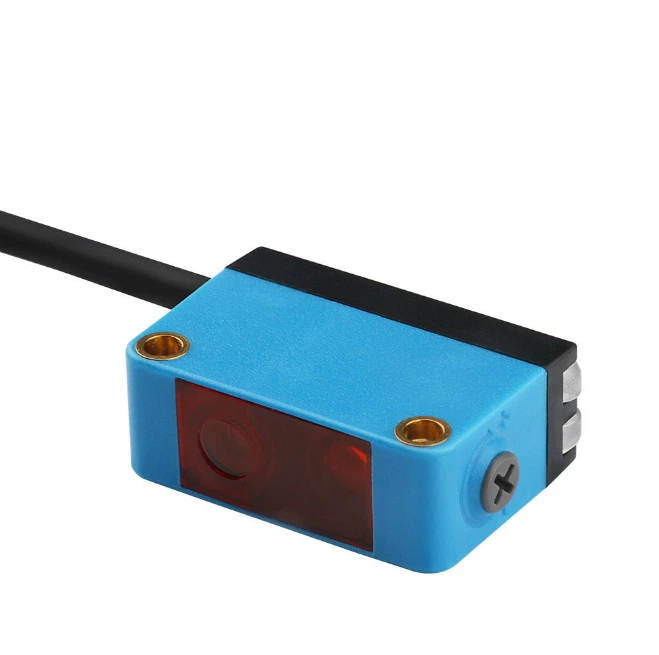
Diffuse Photoelectric Sensor integrates a transmitter and receiver. Under normal circumstances, the receiver cannot receive the light signal from the transmitter. When the object enters the detection range, the emitted light strikes its surface, creating a diffuse reflection effect. Some of the light is reflected back, and the receiver receives the light signal and outputs a switch control signal. Diffuse reflection photoelectric sensors have a distance adjustment function. In industrial control sites and other applications, distance adjustment is required to determine the detection range. This is achieved by adjusting the sensitivity of the receiver to change the detection distance.
Advantages
1. Easy Installation and High Adaptability
A major advantage of diffuse photoelectric sensors is their installation flexibility. Unlike through-beam or retro-reflective sensors, which require precise alignment of the emitter and receiver, diffuse optical sensors require only one-sided installation and operate by detecting light reflected from an object's surface. This makes them ideal for applications where space is limited or reflective panels are difficult to install, such as narrow assembly lines, on mobile equipment, or in complex mechanical structures.
These sensors are highly tolerant of mounting angles, maintaining stable detection even with slight misalignment. For factories that frequently adjust production line layouts, this feature significantly reduces commissioning time and improves production efficiency.
2. Compatible with a variety of materials and surfaces
The detection capabilities of diffuse reflective photoelectric sensors are not limited by the object's material. Whether it's metal, plastic, paper, or a rough surface, as long as the object reflects sufficient light, the sensor will respond effectively. This feature makes them widely used in industries such as packaging, logistics, and printing. For example, when inspecting carton seals, the sensor can reliably detect even light and dark paper.
However, it's important to note that for highly reflective or completely black objects, it may be necessary to adjust the sensor's sensitivity or select a specialized model to ensure stable detection.
3. Fast Response Speed and High Real-Time Performance
In high-speed automation scenarios, sensor response speed directly impacts production efficiency. Diffuse photoelectric sensors typically have a response time of milliseconds, enabling them to quickly detect changes in the state of moving objects. For example, on a beverage filling line, they can detect whether bottle caps are in place in real time, ensuring a seamless filling process.
This high response speed also makes them suitable for use in applications such as sorting systems and high-speed counting, enabling users to achieve precise control and reduce operational errors.
4. Strong Environmental Adaptability
Industrial sites are often subject to interference factors such as dust, oil, and slight vibrations. Diffuse photo electric sensors typically feature a certain degree of anti-interference design, such as an IP67 rating for dust and water resistance, ensuring stable operation in harsh environments. Some models also feature background suppression, ignoring distant interference objects and detecting only targets within a set range.
Of course, in extreme environments (such as direct sunlight or dense smoke), it's still necessary to select a more specialized sensor type based on specific needs.
5. Outstanding Cost-Effectiveness
Compared to other complex photoelectric detection solutions, diffuse reflection sensors offer a simple structure and lower cost. They provide a cost-effective detection method for small and medium-sized businesses with limited budgets. For example, in common production line material inspection, using diffuse reflection sensors typically saves 30%-50% in hardware costs compared to through-beam sensors, while also reducing maintenance workload.
These sensors also have a long lifespan, typically reaching tens of thousands of hours, further reducing overall costs over the long term.



FAQ
Q:Can this diffuse reflective sensor pick up dark matte plastic parts without frequent false triggers on our packaging line?
A:It works well for most dark plastic items as long as you turn down the detection sensitivity a little bit. Pure black rubber with extremely low reflectivity will need a shorter sensing distance to stay stable. If your production environment has strong overhead workshop lights, we suggest mounting the sensor at a slight angle to cut down light interference.
Q:Does this diffuse photo eye come with both NPN and PNP output options for our different PLC control cabinets?
A:We support both output types for this diffuse reflective model. You just need to note your required signal type when sending an inquiry. All units carry IP67 casing to block water splashes and fine metal shavings, fitting most assembly, filling and sorting production lines.
Q:What differences separate diffuse reflective sensors from through-beam photoelectric sensors when picking parts on automated conveyors?
A:Diffuse types only require one single sensor unit, so installation and wiring take far less time and cut hardware costs. Their downside is limited detection distance and weaker performance for ultra-dark workpieces. Through-beam sensors use separate transmitter and receiver heads, deliver much longer sensing range, and perform more consistently with dark or irregular-shaped goods, though they cost more and need aligned mounting on two sides of the conveyor.
Hot Tags: diffuse photoelectric sensor, China diffuse photoelectric sensor manufacturers, suppliers, factory, photoelectric safety sensor, indoor photocell light switch, opposed photoelectric sensor, Optical Diffuse Sensor, diffuse reflective type sensor, photoelectric based detectors